

[Oct 03, 2023] Pass AZ-500 Review Guide, Reliable AZ-500 Test Engine
AZ-500 Test Engine Practice Test Questions, Exam Dumps
Microsoft AZ-500 exam consists of various topics related to Microsoft Azure security technologies. AZ-500 exam requires a deep understanding of Azure security services, including Azure Active Directory, Azure Security Center, Azure Key Vault, Azure Information Protection, and Azure Sentinel. AZ-500 exam also covers the implementation of security controls for Azure resources, such as virtual machines, storage accounts, and network security groups.
Microsoft AZ-500 exam is a highly sought-after certification exam for IT professionals who want to advance their career in cloud security. AZ-500 exam is ideal for those who have experience in Azure and want to specialize in security. The AZ-500 certification is recognized by employers worldwide, making it a valuable asset for individuals who want to stand out in the job market. Microsoft Azure Security Technologies certification demonstrates that the candidate has the knowledge and skills required to secure Azure environments and protect sensitive data.
NEW QUESTION # 174
You create a new Azure subscription that is associated to a new Azure Active Directory (Azure AD) tenant.
You create one active conditional access policy named Portal Policy. Portal Policy is used to provide access to the Microsoft Azure Management cloud app.
The Conditions settings for Portal Policy are configured as shown in the Conditions exhibit. (Click the Conditions tab.)
The Grant settings for Portal Policy are configured as shown in the Grant exhibit. (Click the Grant tab.)
For each of the following statements, select Yes if the statement is true. Otherwise, select No.
NOTE: Each correct selection is worth one point.
Answer:
Explanation:
Explanation
Box 1: No
The Contoso location is excluded
Box 2: NO
Box 3: NO
Reference:
https://docs.microsoft.com/en-us/azure/active-directory/conditional-access/location-condition
NEW QUESTION # 175
You are implementing conditional access policies.
You must evaluate the existing Azure Active Directory (Azure AD) risk events and risk levels to configure and implement the policies.
You need to identify the risk level of the following risk events:
Users with leaked credentials
Impossible travel to atypical locations
Sign ins from IP addresses with suspicious activity
Which level should you identify for each risk event? To answer, drag the appropriate levels to the correct risk events. Each level may be used once, more than once, or not at all. You may need to drag the split bar between panes or scroll to view content.
NOTE: Each correct selection is worth one point.
Answer:
Explanation:
NEW QUESTION # 176
You have an Azure Active Directory (Azure AD) tenant named contoso.com that contains the users shown in the following table.
Azure AD Privileged Identity Management (PIM) is enabled for the tenant.
In PIM, the Password Administrator role has the following settings:
Maximum activation duration (hours): 2
Send email notifying admins of activation: Disable
Require incident/request ticket number during activation: Disable
Require Azure Multi-Factor Authentication for activation: Enable
Require approval to activate this role: Enable
Selected approver: Group1
You assign users the Password Administrator role as shown in the following table.
For each of the following statements, select Yes if the statement is true. Otherwise, select No.
NOTE: Each correct selection is worth one point.
Answer:
Explanation:
NEW QUESTION # 177
You have an Azure Active Directory (Azure AD) tenant named contoso1812.onmicrosoft.com that contains the users shown in the following table.
You create an Azure Information Protection label named Label1. The Protection settings for Label1 are configured as shown in the exhibit. (Click the Exhibit tab.)
Label1 is applied to a file named File1.
For each of the following statements, select Yes if the statement is true, Otherwise, select No.
NOTE: Each correct selection is worth one point.
Answer:
Explanation:
Explanation
NEW QUESTION # 178
You have 20 Azure subscriptions and a security group named Group1. The subscriptions are children of the root management group.
Each subscription contains a resource group named RG1.
You need to ensure that for each subscription RG1 meets the following requirements:
The members of Group1 are assigned the Owner role.
The modification of permissions to RG1 is prevented.
What should you do? To answer, select the appropriate options in the answer area.
NOTE: Each correct selection is worth one point.
Answer:
Explanation:
NEW QUESTION # 179
You have an Azure subscription that contains the virtual machines shown in the following table.
VNET1, VNET2, and VNET3 are peered with each other. You perform the following actions:
* Create two application security groups named ASG1 and ASG2 in the West US region.
* Add the network interface of VM1 to ASG1.
Answer:
Explanation:
NEW QUESTION # 180
You create an Azure subscription with Azure AD Premium P2.
You need to ensure that you can use Azure Active Directory (Azure AD) Privileged Identity Management (PIM) to secure Azure roles.
Which three actions should you perform in sequence? To answer, move the appropriate actions from the list of actions to the answer area and arrange them in the correct order.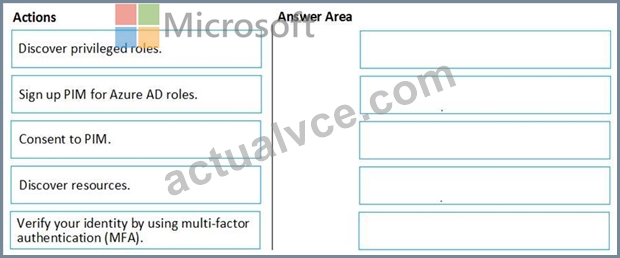
Answer:
Explanation:
Explanation
1. Verify your identity with MFA
2. Consent to PIM
3. Sign up PIM for AAD Roles
NEW QUESTION # 181
You have an Azure subscription that contains the following resources:
A network virtual appliance (NVA) that runs non-Microsoft firewall software and routes all outbound traffic from the virtual machines to the internet An Azure function that contains a script to manage the firewall rules of the NVA Azure Security Center standard tier enabled for all virtual machines An Azure Sentinel workspace
30 virtual machines
You need to ensure that when a high-priority alert is generated in Security Center for a virtual machine, an incident is created in Azure Sentinel and then a script is initiated to configure a firewall rule for the NVA.
How should you configure Azure Sentinel to meet the requirements? To answer, drag the appropriate components to the correct requirements. Each component may be used once, more than once, or not at all. You may need to drag the split bar between panes or scroll to view content.
NOTE: Each correct selection is worth one point.
Answer:
Explanation:
Reference:
https://docs.microsoft.com/en-us/azure/sentinel/create-incidents-from-alerts
https://docs.microsoft.com/en-us/azure/sentinel/connect-azure-security-center
NEW QUESTION # 182
You need to create an Azure key vault. The solution must ensure that any object deleted from the key vault be retained for 90 days.
How should you complete the command? To answer, select the appropriate options in the answer area.
NOTE: Each correct selection is worth one point.
Answer:
Explanation:
Explanation
Box 1: -EnablePurgeProtection
If specified, protection against immediate deletion is enabled for this vault; requires soft delete to be enabled as well.
Box 2: -EnableSoftDelete
Specifies that the soft-delete functionality is enabled for this key vault. When soft-delete is enabled, for a grace period, you can recover this key vault and its contents after it is deleted.
References:
https://docs.microsoft.com/en-us/powershell/module/azurerm.keyvault/new-azurermkeyvault
NEW QUESTION # 183
You have an Azure subscription named Sub1. Sub1 has an Azure Storage account named Storage1 that contains the resources shown in the following table.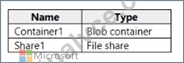
You generate a shared access signature (SAS) to connect to the blob service and the file service.
Which tool can you use to access the contents in Container1 and Share! by using the SAS? To answer, select the appropriate options in the answer area.
NOTE: Each correct selection is worth one point.
Answer:
Explanation:
NEW QUESTION # 184
You have two Azure virtual machines in the East US2 region as shown in the following table.
You deploy and configure an Azure Key vault.
You need to ensure that you can enable Azure Disk Encryption on VM1 and VM2.
What should you modify on each virtual machine? To answer, select the appropriate options in the answer area.
NOTE: Each correct selection is worth one point.
Answer:
Explanation:
Explanation
VM1: The Tier
The Tier needs to be upgraded to standard.
Disk Encryption for Windows and Linux IaaS VMs is in General Availability in all Azure public regions and Azure Government regions for Standard VMs and VMs with Azure Premium Storage.
VM2: the operating system
References:
https://docs.microsoft.com/en-us/azure/virtual-machines/windows/generation-2#generation-1-vs-generation-2-ca
NEW QUESTION # 185
You have an Azure subscription named Subcription1 that contains the resources shown in the following table.
You create an Azure role by using the following JSON file.
You assign Role1 to User1 for RG1.
For each of the following statement, select Yes if the statement is true. Otherwise, select No.
Note: Each correct selection is worth one point.
Answer:
Explanation:
NEW QUESTION # 186
You have an Azure subscription that contains the resources show in the following table.
Both VM1 and VM2 connect to VNET1 and are configured to use NSG1.
You need to ensure that only VM1 and VM2 can access DB1.
What should you do?
- A. For NSG1, configure a rule that has a service tag.
- B. Add the IP address range of VNET1 to the Firewall setting of DB1.
- C. Create an application security group.
- D. Configure DB1 to allow access from only VNET1.
Answer: A
NEW QUESTION # 187
You have an Azure subscription named Sub1 that contains the resource groups shown in the following table.
You create the Azure Policy definition shown in the following exhibit.
You assign the policy to Sub1.
You plan to create the resources shown in the following table.
For each of the following statements, select Yes if the statement is true. Otherwise, select No.
NOTE: Each correct selection is worth one point.
Answer:
Explanation:
Explanation
NEW QUESTION # 188
You have an Azure subscription that contains a user named User1 and a storage account named storage 1. The storage1 account contains the resources shown in the following table:
User1 is assigned the following roles for storage1:
* Storage Blob Data Reader
* Storage Table Data Contributor
* Storage File Data SMB Share Reader
Answer:
Explanation:
NEW QUESTION # 189
You have 10 virtual machines on a single subnet that has a single network security group (NSG).
You need to log the network traffic to an Azure Storage account.
Which two actions should you perform? Each correct answer presents part of the solution.
NOTE: Each correct selection is worth one point.
- A. Install the Network Performance Monitor solution.
- B. Create an Azure Log Analytics workspace.
- C. Enable NSG flow logs.
- D. Enable diagnostic logging for the NSG.
- E. Enable Azure Network Watcher.
Answer: C,E
Explanation:
Explanation
A network security group (NSG) enables you to filter inbound traffic to, and outbound traffic from, a virtual machine (VM). You can log network traffic that flows through an NSG with Network Watcher's NSG flow log capability. Steps include:
* Create a VM with a network security group
* Enable Network Watcher and register the Microsoft.Insights provider
* Enable a traffic flow log for an NSG, using Network Watcher's NSG flow log capability
* Download logged data
* View logged data
Reference:
https://docs.microsoft.com/en-us/azure/network-watcher/network-watcher-nsg-flow-logging-portal
NEW QUESTION # 190
You are configuring an Azure Kubernetes Service (AKS) cluster that will connect to an Azure Container
Registry.
You need to use the auto-generated service principal to authenticate to the Azure Container Registry.
What should you create?
- A. an Azure Active Directory (Azure AD) user
- B. an Azure Active Directory (Azure AD) role assignment
- C. an Azure Active Directory (Azure AD) group
- D. a secret in Azure Key Vault
Answer: B
Explanation:
When you create an AKS cluster, Azure also creates a service principal to support cluster operability with other Azure resources. You can use this auto-generated service principal for authentication with an ACR registry. To do so, you need to create an Azure AD role assignment that grants the cluster's service principal access to the container registry.
Reference:
https://docs.microsoft.com/bs-latn-ba/azure/container-registry/container-registry-auth-aks
NEW QUESTION # 191
You have an Azure key vault.
You need to delegate administrative access to the key vault to meet the following requirements:
Provide a user named User1 with the ability to set advanced access policies for the key vault.
Provide a user named User2 with the ability to add and delete certificates in the key vault.
Use the principle of least privilege.
What should you use to assign access to each user? To answer, select the appropriate options in the answer area.
NOTE: Each correct selection is worth one point.
Answer:
Explanation:
Reference:
https://docs.microsoft.com/en-us/azure/key-vault/key-vault-secure-your-key-vault
NEW QUESTION # 192
You need to ensure that connections from the Internet to VNET1\subnet0 are allowed only over TCP port
7777. The solution must use only currently deployed resources.
To complete this task, sign in to the Azure portal.
Answer:
Explanation:
See the explanation below.
Explanation
You need to configure the Network Security Group that is associated with subnet0.
* In the Azure portal, type Virtual Networks in the search box, select Virtual Networks from the search results then select VNET1. Alternatively, browse to Virtual Networks in the left navigation pane.
* In the properties of VNET1, click on Subnets. This will display the subnets in VNET1 and the Network Security Group associated to each subnet. Note the name of the Network Security Group associated to Subnet0.
* Type Network Security Groups into the search box and select the Network Security Group associated with Subnet0.
* In the properties of the Network Security Group, click on Inbound Security Rules.
* Click the Add button to add a new rule.
* In the Source field, select Service Tag.
* In the Source Service Tag field, select Internet.
* Leave the Source port ranges and Destination field as the default values (* and All).
* In the Destination port ranges field, enter 7777.
* Change the Protocol to TCP.
* Leave the Action option as Allow.
* Change the Priority to 100.
* Change the Name from the default Port_8080 to something more descriptive such as Allow_TCP_7777_from_Internet. The name cannot contain spaces.
* Click the Add button to save the new rule.
NEW QUESTION # 193
Your company has an Azure Active Directory (Azure AD) tenant named contoso.com.
The company is developing an application named App1. App1 will run as a service on server that runs Windows Server 2016. App1 will authenticate to contoso.com and access Microsoft Graph to read directory data.
You need to delegate the minimum required permissions to App1.
Which three actions should you perform in sequence from the Azure portal? To answer, move the appropriate actions from the list of actions to the answer area and arrange them in the correct order.
Answer:
Explanation:
Explanation
Step 1: Create an app registration
First the application must be created/registered.
Step 2: Add an application permission
Application permissions are used by apps that run without a signed-in user present.
Step 3: Grant permissions
NEW QUESTION # 194
You have an Azure subscription that contains the virtual networks shown in the following table.
The subscription contains the virtual machines shown in the following table.
On NIC1, you configure an application security group named ASG1.
On which other network interfaces can you configure ASG1?
- A. NIC2 only
- B. NIC2, NIC3, and NIC4 only
- C. NIC2, NIC3, NIC4, and NIC5
- D. NIC2 and NIC3 only
Answer: D
Explanation:
Section: [none]
Explanation:
Only network interfaces in NVET1, which consists of Subnet11 and Subnet12, can be configured in ASG1, as all network interfaces assigned to an application security group have to exist in the same virtual network that the first network interface assigned to the application security group is in.
Reference:
https://azure.microsoft.com/es-es/blog/applicationsecuritygroups/
NEW QUESTION # 195
You have an Azure Active Directory (Azure AD) tenant named contoso.com that contains the users shown in the following table.
Contoso.com contains a group naming policy. The policy has a custom blocked word list rule that includes the word Contoso.
Which users can create a group named Contoso Sales in contoso.com? To answer, select the appropriate options in the answer area.
NOTE: Each correct selection is worth one point.
Answer:
Explanation:
Explanation
Reference:
https://docs.microsoft.com/en-us/azure/active-directory/enterprise-users/groups-naming-policy
NEW QUESTION # 196
Note: This question is part of a series of questions that present the same scenario. Each question in the series contains a unique solution that might meet the stated goals. Some question sets might have more than one correct solution, while others might not have a correct solution.
After you answer a question in this section, you will NOT be able to return to it. As a result, these questions will not appear in the review screen.
You have a hybrid configuration of Azure Active Directory (Azure AD).
You have an Azure HDInsight cluster on a virtual network.
You plan to allow users to authenticate to the cluster by using their on-premises Active Directory credentials.
You need to configure the environment to support the planned authentication.
Solution: You deploy Azure Active Directory Domain Services (Azure AD DS) to the Azure subscription.
Does this meet the goal?
- A. No
- B. Yes
Answer: B
Explanation:
Explanation
References:
https://docs.microsoft.com/en-us/azure/hdinsight/domain-joined/apache-domain-joined-configure-using-azure-a
NEW QUESTION # 197
You have an Azure subscription named Sub1 that contains an Azure Log Analytics workspace named LAW1.
You have 100 on-premises servers that run Windows Server 2012 R2 and Windows Server 2016. The servers connect to LAW1. LAW1 is configured to collect security-related performance counters from the connected servers.
You need to configure alerts based on the data collected by LAW1. The solution must meet the following requirements:
Alert rules must support dimensions.
The time it takes to generate an alert must be minimized.
Alert notifications must be generated only once when the alert is generated and once when the alert is
resolved.
Which signal type should you use when you create the alert rules?
- A. Log (Saved Query)
- B. Activity Log
- C. Log
- D. Metric
Answer: D
Explanation:
Metric alerts in Azure Monitor provide a way to get notified when one of your metrics cross a threshold. Metric alerts work on a range of multi-dimensional platform metrics, custom metrics, Application Insights standard and custom metrics.
Note: Signals are emitted by the target resource and can be of several types. Metric, Activity log, Application Insights, and Log.
Reference:
https://docs.microsoft.com/en-us/azure/azure-monitor/platform/alerts-metric
NEW QUESTION # 198
You have an Azure subscription that contains a virtual network. The virtual network contains the subnets shown in the following table.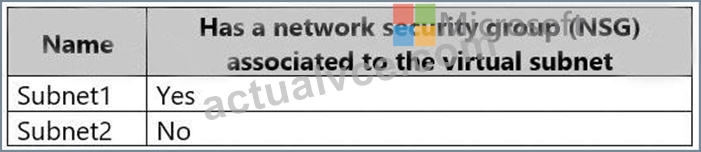
The subscription contains the virtual machines shown in the following table.
You enable just in time (JIT) VM access for all the virtual machines.
You need to identify which virtual machines are protected by JIT.
Which virtual machines should you identify?
- A. VM4 only
- B. VM1 and VM3 only
- C. VM1, VM2, VM3, and VM4
- D. VM1, VM3 and VM4 only
Answer: D
Explanation:
Explanation
An NSG needs to be enabled, either at the VM level or the subnet level.
Reference:
https://docs.microsoft.com/en-us/azure/security-center/security-center-just-in-time
NEW QUESTION # 199
......
Microsoft AZ-500 certification exam is designed for professionals who want to demonstrate their skills in implementing security controls, maintaining security posture, and identifying and remediating vulnerabilities in the Microsoft Azure cloud platform. AZ-500 exam measures the candidate's ability to secure applications, data, and identities in the cloud environment using various security tools and services provided by Microsoft.
100% Free AZ-500 Daily Practice Exam With 377 Questions: https://learningtree.actualvce.com/Microsoft/AZ-500-valid-vce-dumps.html