

[Dec-2021 Newly Released] AZ-500 Dumps for Microsoft Azure Security Engineer Associate Certified
Updated Verified AZ-500 dumps Q&As - 100% Pass
NEW QUESTION 82
You have an Azure subscription.
You enable Azure Active Directory (Azure AD) Privileged Identity Management (PIM).
Your company's security policy for administrator accounts has the following conditions:
* The accounts must use multi-factor authentication (MFA).
* The accounts must use 20-character complex passwords.
* The passwords must be changed every 180 days.
* The accounts must be managed by using PIM.
You receive multiple alerts about administrators who have not changed their password during the last 90 days.
You need to minimize the number of generated alerts.
Which PIM alert should you modify?
- A. Potential stale accounts in a privileged role
- B. Administrators aren't using their privileged roles
- C. Roles are being assigned outside of Privileged Identity Management
- D. Roles don't require multi-factor authentication for activation
Answer: A
Explanation:
Section: [none]
Explanation/Reference:
https://docs.microsoft.com/en-us/azure/active-directory/privileged-identity-management/pim-how-to-configure- security-alerts?tabs=new
NEW QUESTION 83
You have an Azure subscription that contains an Azure Active Directory (Azure AD) tenant and a user named User1.
The App registrations settings for the tenant are configured as shown in the following exhibit.
You plan to deploy an app named App1.
You need to ensure that User1 can register App1 in Azure AD. The solution must use the principle of least privilege.
Which role should you assign to User1?
- A. App Configuration Data Owner for the subscription
- B. Managed Application Contributor for the subscription
- C. Application developer in Azure AD.
- D. Cloud application administrator in Azure AD
Answer: C
Explanation:
Reference:
https://docs.microsoft.com/en-us/azure/active-directory/roles/delegate-by-task
NEW QUESTION 84
You have an Azure key vault.
You need to delegate administrative access to the key vault to meet the following requirements:
Provide a user named User1 with the ability to set advanced access policies for the key vault.
Provide a user named User2 with the ability to add and delete certificates in the key vault.
Use the principle of least privilege.
What should you use to assign access to each user? To answer, select the appropriate options in the answer area.
NOTE: Each correct selection is worth one point.
Answer:
Explanation:
References:
https://docs.microsoft.com/en-us/azure/key-vault/key-vault-secure-your-key-vault
NEW QUESTION 85
You have a hybrid configuration of Azure Active Directory (Azure AD).
All users have computers that run Windows 10 and are hybrid Azure AD joined.
You have an Azure SQL database that is configured to support Azure AD authentication.
Database developers must connect to the SQL database by using Microsoft SQL Server Management
Studio (SSMS) and authenticate by using their on-premises Active Directory account.
You need to tell the developers which authentication method to use to connect to the SQL database from
SSMS. The solution must minimize authentication prompts.
Which authentication method should you instruct the developers to use?
- A. Active Directory - Integrated
- B. Active Directory - Universal with MFA support
- C. SQL Login
- D. Active Directory - Password
Answer: A
Explanation:
Explanation/Reference:
Explanation:
Azure AD can be the initial Azure AD managed domain. Azure AD can also be an on-premises Active
Directory Domain Services that is federated with the Azure AD.
Using an Azure AD identity to connect using SSMS or SSDT
The following procedures show you how to connect to a SQL database with an Azure AD identity using
SQL Server Management Studio or SQL Server Database Tools.
Active Directory integrated authentication
Use this method if you are logged in to Windows using your Azure Active Directory credentials from a
federated domain.
1. Start Management Studio or Data Tools and in the Connect to Server (or Connect to Database Engine)
dialog box, in the Authentication box, select Active Directory - Integrated. No password is needed or can
be entered because your existing credentials will be presented for the connection.
2. Select the Options button, and on the Connection Properties page, in the Connect to database box, type
the name of the user database you want to connect to. (The AD domain name or tenant ID" option is only
supported for Universal with MFA connection options, otherwise it is greyed out.)
References:
https://github.com/MicrosoftDocs/azure-docs/blob/master/articles/sql-database/sql-database-aad-
authentication-configure.md
AZ-500
AZ-500
Testlet 1
This is a case study. Case studies are not timed separately. You can use as much exam time as you would
like to complete each case. However, there may be additional case studies and sections on this exam. You
must manage your time to ensure that you are able to complete all questions included on this exam in the
time provided.
To answer the questions included in a case study, you will need to reference information that is provided in
the case study. Case studies might contain exhibits and other resources that provide more information
about the scenario that is described in the case study. Each question is independent of the other question
on this case study.
At the end of this case study, a review screen will appear. This screen allows you to review your answers
and to make changes before you move to the next sections of the exam. After you begin a new section,
you cannot return to this section.
To start the case study
To display the first question on this case study, click the Next button. Use the buttons in the left pane to
explore the content of the case study before you answer the questions. Clicking these buttons displays
information such as business requirements, existing environment, and problem statements. If the case
study has an All Information tab, note that the information displayed is identical to the information displayed
on the subsequent tabs. When you are ready to answer a question, click the Question button to return to
the question.
Overview
Litware, Inc. is a digital media company that has 500 employees in the Chicago area and 20 employees in
the San Francisco area.
Existing Environment
Litware has an Azure subscription named Sub1 that has a subscription ID of 43894a43-17c2-4a39-8cfc-
3540c2653ef4.
Sub1 is associated to an Azure Active Directory (Azure AD) tenant named litwareinc.com. The tenant
contains the user objects and the device objects of all the Litware employees and their devices. Each user
is assigned an Azure AD Premium P2 license. Azure AD Privileged Identity Management (PIM) is
activated.
The tenant contains the groups shown in the following table.
The Azure subscription contains the objects shown in the following table.
Azure Security Center is set to the Free tier.
Planned changes
Litware plans to deploy the Azure resources shown in the following table.
Litware identifies the following identity and access requirements:
All San Francisco users and their devices must be members of Group1.
The members of Group2 must be assigned the Contributor role to Resource Group2 by using a
permanent eligible assignment.
Users must be prevented from registering applications in Azure AD and from consenting to applications
that access company information on the users' behalf.
Platform Protection Requirements
Litware identifies the following platform protection requirements:
Microsoft Antimalware must be installed on the virtual machines in Resource Group1.
The members of Group2 must be assigned the Azure Kubernetes Service Cluster Admin Role.
Azure AD users must be to authenticate to AKS1 by using their Azure AD credentials.
Following the implementation of the planned changes, the IT team must be able to connect to VM0 by
using JIT VM access.
A new custom RBAC role named Role1 must be used to delegate the administration of the managed
disks in Resource Group1. Role1 must be available only for Resource Group1.
Security Operations Requirements
Litware must be able to customize the operating system security configurations in Azure Security Center.
NEW QUESTION 86
You have an Azure subscription. The subscription contains Azure virtual machines that run Windows Server
2016.
You need to implement a policy to ensure that each virtual machine has a custom antimalware virtual machine extension installed.
How should you complete the policy? To answer, select the appropriate options in the answer area.
NOTE: Each correct selection is worth one point.
Answer:
Explanation:
Explanation
Box 1: DeployIfNotExists
DeployIfNotExists executes a template deployment when the condition is met.
Box 2: Template
The details property of the DeployIfNotExists effects has all the subproperties that define the related resources to match and the template deployment to execute.
Deployment [required]
This property should include the full template deployment as it would be passed to the Microsoft.Resources/deployment References:
https://docs.microsoft.com/en-us/azure/governance/policy/concepts/effects
NEW QUESTION 87
SIMULATION
You need to ensure that the AzureBackupReport log for the Vault1 Recovery Services vault is stored in the WS11641655 Azure Log Analytics workspace.
To complete this task, sign in to the Azure portal and modify the Azure resources.
- A. 1. In the Azure portal, type Recovery Services Vaults in the search box, select Recovery Services Vaults from the search results then select Vault1. Alternatively, browse to Recovery Services Vaults in the left navigation pane.
2. In the properties of Vault1, scroll down to the Monitoring section and select Diagnostic Settings.
3. Click the Add a diagnostic setting link.
4. In the Destination details section, select Send to log analytics
5. Select the WS11641655 Azure Log Analytics workspace.
6. Click the Save button to save the changes. - B. 1. In the Azure portal, type Recovery Services Vaults in the search box, select Recovery Services Vaults from the search results then select Vault1. Alternatively, browse to Recovery Services Vaults in the left navigation pane.
2. In the properties of Vault1, scroll down to the Monitoring section and select Diagnostic Settings.
3. Click the Add a diagnostic setting link.
4. Enter a name in the Diagnostic settings name box.
5. In the Log section, select AzureBackupReport.
6. In the Destination details section, select Send to log analytics
7. Select the WS11641655 Azure Log Analytics workspace.
8. Click the Save button to save the changes.
Answer: B
Explanation:
Reference:
https://docs.microsoft.com/en-us/azure/backup/backup-azure-diagnostic-events
NEW QUESTION 88
DRAG DROP
You have an Azure subscription named Sub1 that contains an Azure Storage account named contosostorage1 and an Azure key vault named Contosokeyvault1.
You plan to create an Azure Automation runbook that will rotate the keys of contosostorage1 and store them in Contosokeyvault1.
You need to implement prerequisites to ensure that you can implement the runbook.
Which three actions should you perform in sequence? To answer, move the appropriate actions from the list of actions to the answer area and arrange them in the correct order.
Select and Place:
Answer:
Explanation:
Explanation:
Step 1: Create an Azure Automation account
Runbooks live within the Azure Automation account and can execute PowerShell scripts.
Step 2: Import PowerShell modules to the Azure Automation account
Under 'Assets' from the Azure Automation account Resources section select 'to add in Modules to the runbook. To execute key vault cmdlets in the runbook, we need to add AzureRM.profile and AzureRM.key vault.
Step 3: Create a connection resource in the Azure Automation account
You can use the sample code below, taken from the AzureAutomationTutorialScript example runbook, to authenticate using the Run As account to manage Resource Manager resources with your runbooks. The AzureRunAsConnection is a connection asset automatically created when we created 'run as accounts' above.
This can be found under Assets -> Connections. After the authentication code, run the same code above to get all the keys from the vault.
$connectionName = "AzureRunAsConnection"
try
{
# Get the connection "AzureRunAsConnection "
$servicePrincipalConnection=Get-AutomationConnection -Name $connectionName
"Logging in to Azure..."
Add-AzureRmAccount `
-ServicePrincipal `
-TenantId $servicePrincipalConnection.TenantId `
-ApplicationId $servicePrincipalConnection.ApplicationId `
-CertificateThumbprint $servicePrincipalConnection.CertificateThumbprint
}
References:
https://www.rahulpnath.com/blog/accessing-azure-key-vault-from-azure-runbook/
NEW QUESTION 89
You have an Azure subscription that contains 100 virtual machines and has Azure Security Center Standard tier enabled.
You plan to perform a vulnerability scan of each virtual machine.
You need to deploy the vulnerability scanner extension to the virtual machines by using an Azure Resource Manager template.
Which two values should you specify in the code to automate the deployment of the extension to the virtual machines? Each correct answer presents part of the solution.
NOTE: Each correct selection is worth one point.
- A. the workspace ID
- B. the system-assigned managed identity
- C. the Azure Active Directory (Azure AD) ID
- D. the Key Vault managed storage account key
- E. the primary shared key
- F. the user-assigned managed identity
Answer: C,F
Explanation:
https://www.fast2test.com/AZ-500-practice-test.html 66
Valid Fast2test AZ-500 Exam PDF Dumps - New AZ-500 Real Exam Questions
NEW QUESTION 90
You are evaluating the effect of the application security groups on the network communication between the virtual machines in Sub2.
For each of the following statements, select Yes if the statement is true. Otherwise, select No.
NOTE: Each correct selection is worth one point.
Answer:
Explanation:
Explanation
Box 1: No. VM4 is in Subnet13 which has NSG3 attached to it.
VM1 is in ASG1. NSG3 would only allow ICMP pings from ASG2 but not ASG1. Only TCP traffic is allowed from ASG1.
NSG3 has the inbound security rules shown in the following table.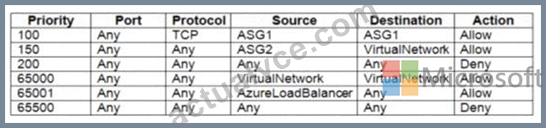
Box 2: Yes.
VM2 is in ASG2. Any protocol is allowed from ASG2 so ICMP ping would be allowed.
Box3. VM1 is in ASG1. TCP traffic is allowed from ASG1 so VM1 could connect to the web server as connections to the web server would be on ports TCP 80 or TCP 443.
NEW QUESTION 91
You have a hybrid configuration of Azure Active Directory (Azure AD) that has Single Sign-On (SSO) enabled.
You have an Azure SQL Database instance that is configured to support Azure AD authentication.
Database developers must connect to the database instance from the domain joined device and authenticate by using their on-premises Active Directory account.
You need to ensure that developers can connect to the instance by using Microsoft SQL Server Management Studio. The solution must minimize authentication prompts.
Which authentication method should you recommend?
- A. Active Directory - Integrated
- B. Active Directory - Universal with MFA support
- C. Active Directory - Password
- D. SQL Server Authentication
Answer: A
Explanation:
Active Directory - Integrated
Azure Active Directory Authentication is a mechanism of connecting to Microsoft Azure SQL Database by using identities in Azure Active Directory (Azure AD). Use this method for connecting to SQL Database if you are logged in to Windows using your Azure Active Directory credentials from a federated domain.
Reference:
https://docs.microsoft.com/en-us/sql/ssms/f1-help/connect-to-server-database-engine?view=sql-server-2017
https://docs.microsoft.com/en-us/azure/sql-database/sql-database-aad-authentication-configure
NEW QUESTION 92
You are evaluating the security of the network communication between the virtual machines in Sub2.
For each of the following statements, select Yes if the statement is true. Otherwise, select No.
NOTE: Each correct selection is worth one point.
Answer:
Explanation:
NEW QUESTION 93
You have an Azure subscription that contains the virtual machines shown in the following table.
You create the Azure policies shown in the following table.
You create the resource locks shown in the following table.
For each of the following statements, select Yes if the statement is true. Otherwise, select No.
NOTE: Each correct selection is worth one point.
Answer:
Explanation:
NEW QUESTION 94
You need to configure SQLDB1 to meet the data and application requirements.
Which three actions should you recommend be performed in sequence? To answer, move the appropriate actions from the list of actions to the answer area and arrange them in the correct order.
Answer:
Explanation:
Explanation
Step 1: Connect to SQLDB1 by using Microsoft SQL Server Management Studio (SSMS) Step 2: In SQLDB1, create contained database users.
Create a contained user in the database that represents the VM's system-assigned identity.
Step 3: In Azure AD,create a system-assigned managed identity.
A system-assigned identity for a Windows virtual machine (VM) can be used to access an Azure SQL server.
Managed Service Identities are automatically managed by Azure and enable you to authenticate to services that support Azure AD authentication, without needing to insert credentials into your code.
References:
https://docs.microsoft.com/en-us/azure/active-directory/managed-identities-azure-resources/tutorial-windows-vm
NEW QUESTION 95
You have an Azure key vault named KeyVault1 that contains the items shown in the following table.
In KeyVault, the following events occur in sequence:
Item1 is deleted
Administrator enables soft delete
Item2 and Policy1 are deleted.
For each of the following statements, select Yes if the statement is true. Otherwise, select No.
NOTE: Each correct selection is worth one point.
Answer:
Explanation:
Reference:
https://docs.microsoft.com/en-us/azure/key-vault/general/soft-delete-overview
NEW QUESTION 96
You have an Azure subscription that contains the virtual machines shown in the following table.
You create the Azure policies shown in the following table.
For each of the following statements, select Yes if the statement is true. Otherwise, select No.
NOTE: Each correct selection is worth one point.
Answer:
Explanation:
Explanation
References:
https://docs.microsoft.com/en-us/azure/governance/blueprints/concepts/resource-locking
NEW QUESTION 97
You have the hierarchy of Azure resources shown in the following exhibit.
RG1, RG2, and RG3 are resource groups.
RG2 contains a virtual machine named VM1.
You assign role-based access control (RBAC) roles to the users shown in the following table.
For each of the following statements, select Yes if the statement is true. Otherwise, select No.
NOTE: Each correct selection is worth one point.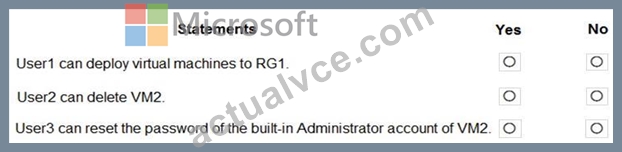
Answer:
Explanation:
Explanation
NEW QUESTION 98
Note: This question is part of a series of questions that present the same scenario. Each question in the series contains a unique solution that might meet the stated goals. Some question sets might have more than one correct solution, while others might not have a correct solution.
After you answer a question in this section, you will NOT be able to return to it. As a result, these questions will not appear in the review screen.
You use Azure Security Center for the centralized policy management of three Azure subscriptions.
You use several policy definitions to manage the security of the subscriptions.
You need to deploy the policy definitions as a group to all three subscriptions.
Solution: You create an initiative and an assignment that is scoped to a management group.
Does this meet the goal?
- A. Yes
- B. No
Answer: A
Explanation:
References:
https://docs.microsoft.com/en-us/azure/governance/policy/overview
NEW QUESTION 99
You need to configure a weekly backup of an Azure SQL database named Homepage. The backup must be retained for eight weeks.
To complete this task, sign in to the Azure portal.
Answer:
Explanation:
See the explanation below.
Explanation
You need to configure the backup policy for the Azure SQL database.
* In the Azure portal, type Azure SQL Database Azure SQL Database from the search results then select Homepage. Alternatively, browse to Azure SQL Database in the left navigation pane.
* Select the server hosting the Manage backups.
* Click on Configure policies.
* Ensure that the Weekly Backups
* Configure the How long would you like weekly backups to be retained option to 8 weeks.
* Click Apply to save the changes.
NEW QUESTION 100
Note: This question is part of a series of questions that present the same scenario. Each question in the series contains a unique solution that might meet the stated goals. Some question sets might have more than one correct solution, while others might not have a correct solution.
After you answer a question in this section, you will NOT be able to return to it. As a result, these questions will not appear in the review screen.
You have a hybrid configuration of Azure Active Directory (Azure AD).
You have an Azure HDInsight cluster on a virtual network.
You plan to allow users to authenticate to the cluster by using their on-premises Active Directory credentials.
You need to configure the environment to support the planned authentication.
Solution: You create a site-to-site VPN between the virtual network and the on-premises network.
Does this meet the goal?
- A. Yes
- B. No
Answer: A
Explanation:
Explanation
Explanation:
You can connect HDInsight to your on-premises network by using Azure Virtual Networks and a VPN gateway.
Note: To allow HDInsight and resources in the joined network to communicate by name, you must perform the following actions:
* Create Azure Virtual Network.
* Create a custom DNS server in the Azure Virtual Network.
* Configure the virtual network to use the custom DNS server instead of the default Azure Recursive Resolver.
* Configure forwarding between the custom DNS server and your on-premises DNS server.
References:
https://docs.microsoft.com/en-us/azure/hdinsight/connect-on-premises-network
NEW QUESTION 101
You need to deploy AKS1 to meet the platform protection requirements.
Which four actions should you perform in sequence? To answer, move the appropriate actions from the list of actions to the answer area and arrange them in the correct order.
NOTE: More than one order of answer choices is correct. You will receive credit for any of the correct orders you select.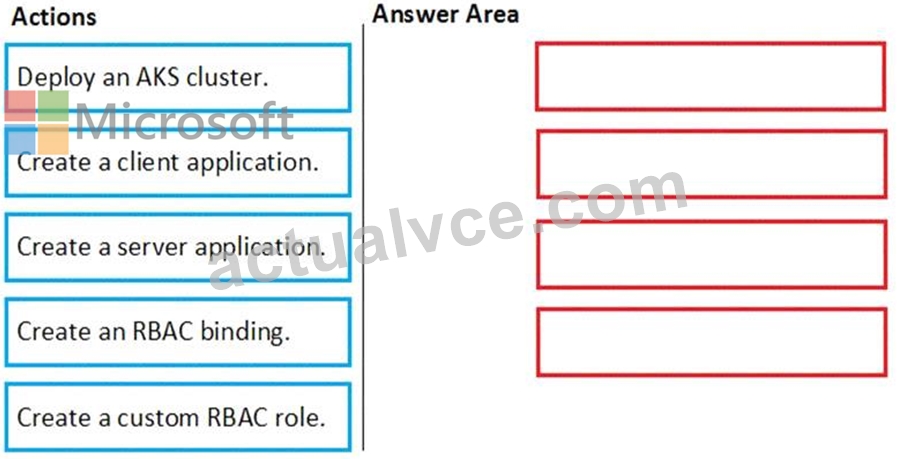
Answer:
Explanation:
Explanation
Scenario: Azure AD users must be to authenticate to AKS1 by using their Azure AD credentials.
Litewire plans to deploy AKS1, which is a managed AKS (Azure Kubernetes Services) cluster.
Step 1: Create a server application
To provide Azure AD authentication for an AKS cluster, two Azure AD applications are created. The first application is a server component that provides user authentication.
Step 2: Create a client application
The second application is a client component that's used when you're prompted by the CLI for authentication.
This client application uses the server application for the actual authentication of the credentials provided by the client.
Step 3: Deploy an AKS cluster.
Use the az group create command to create a resource group for the AKS cluster.
Use the az aks create command to deploy the AKS cluster.
Step 4: Create an RBAC binding.
Before you use an Azure Active Directory account with an AKS cluster, you must create role-binding or cluster role-binding. Roles define the permissions to grant, and bindings apply them to desired users. These assignments can be applied to a given namespace, or across the entire cluster.
Reference:
https://docs.microsoft.com/en-us/azure/aks/azure-ad-integration
NEW QUESTION 102
You have an Azure subscription named Sub1 that is associated to an Azure Active Directory (Azure AD) tenant named contoso.com.
You plan to implement an application that will consist of the resources shown in the following table.
Users will authenticate by using their Azure AD user account and access the Cosmos DB account by using resource tokens.
You need to identify which tasks will be implemented in CosmosDB1 and WebApp1.
Which task should you identify for each resource? To answer, select the appropriate options in the answer area.
NOTE: Each correct selection is worth one point.
Answer:
Explanation:
Explanation
CosmosDB1: Create database users and generate resource tokens.
Azure Cosmos DB resource tokens provide a safe mechanism for allowing clients to read, write, and delete specific resources in an Azure Cosmos DB account according to the granted permissions.
WebApp1: Authenticate Azure AD users and relay resource tokens
A typical approach to requesting, generating, and delivering resource tokens to a mobile application is to use a resource token broker. The following diagram shows a high-level overview of how the sample application uses a resource token broker to manage access to the document database data:
References:
https://docs.microsoft.com/en-us/xamarin/xamarin-forms/data-cloud/cosmosdb/authentication
NEW QUESTION 103
......
Why Choose AZ-500?
This test is attributed to Microsoft Azure technologies associated with security. Only by acing it, the students can prove their abilities in the proper implementation of security control, identification, and access management, as well as in maintaining the security framework. What is more, this test is also associated with the Microsoft Certified: Azure Security Engineer Associate certification.
What Is Your Career Path after AZ-500?
After receiving the aforementioned associate-level certificate, you can also decide to enhance your skills further and bag another certification. There are certifications at the expert-level which are best for anyone seeking to have more say in their career. They include:
- The Microsoft Certified: DevOps Engineer Expert;
- The Microsoft Certified: Azure Solutions Architect Expert.
The first certificate for developers requires passing one test while the latter for solutions architect demands acing two tests. Earning any of them makes you an expert who can command a more advanced role and even a better salary.
Latest AZ-500 Exam Dumps Microsoft Exam from Training: https://learningtree.actualvce.com/Microsoft/AZ-500-valid-vce-dumps.html