

Download Palo Alto Networks XSIAM-Analyst Exam Dumps to Pass Exam Easily in 2025
Get 100% Real Free Security Operations XSIAM-Analyst Sample Questions
NEW QUESTION # 61
While reviewing a dataset's schema, you notice fields for event_type, src_ip, and dest_port. What does this allow you to do in XQL?
(Choose two)
Response:
- A. Automatically update firmware
- B. Build field-specific filters
- C. Predict future incident trends
- D. Generate field-based visualizations
Answer: B,D
NEW QUESTION # 62
What is required to create a custom prioritization rule in Cortex XSIAM?
Response:
- A. Read-only role permissions
- B. Scheduled report exports
- C. Specific alert attributes or tags
- D. Access to Cortex CLI
Answer: C
NEW QUESTION # 63
When a sub-playbook loops, which task tab will allow an analyst to determine what data the sub-playbook used in each iteration of the loop?
- A. Outputs
- B. Input Results
- C. Inputs
- D. Results
Answer: B
Explanation:
The correct answer isA - Input Results.
In Cortex XSIAM playbooks, when sub-playbooks are configured to loop, theInput Resultstab within the task view allows analysts to see exactly what input data was provided to the sub-playbook during each iteration of the loop. This is essential for understanding playbook behavior and troubleshooting automation flows.
"The Input Results tab in the playbook task provides visibility into the data supplied to a sub-playbook for every loop iteration, allowing analysts to review how the input changes across executions." Document Reference:XSIAM Analyst ILT Lab Guide.pdf Page:Page 39 (Automation section)
NEW QUESTION # 64
You're reviewing suspicious IPs imported from VirusTotal. Which two XSIAM actions are valid next steps?
Response:
- A. Create a block rule
- B. Use syslog to flush logs
- C. Update browser cache
- D. Enrich incidents with the indicator
Answer: A,D
NEW QUESTION # 65
Which of the following is NOT a task type in Cortex XSIAM playbooks?
Response:
- A. Reinforcement task
- B. Conditional task
- C. Automation script
- D. Manual task
Answer: A
NEW QUESTION # 66
Match each alert evidence type with its investigation value:
Alert Evidence
A) Timeline
B) ITDR Findings
C) Causality Chain
D) File Hash
Use in Investigation
1. Tracks sequence of events
2. Indicates identity misuse
3. Shows parent-child process lineage
4. Maps to known malware indicators
Response:
- A. A-1, B-2, C-3, D-4
- B. A-1, B-2, C-4, D-3
- C. A-4, B-2, C-3, D-1
- D. A-1, B-3, C-2, D-4
Answer: A
NEW QUESTION # 67
Which action can be performed through custom prioritization logic?
Response:
- A. Restart the agent remotely
- B. Modify the alert source
- C. Export raw logs to CSV
- D. Increase incident score based on alert tags
Answer: D
NEW QUESTION # 68
What triggers the automatic creation of an incident in Cortex XSIAM?
Response:
- A. A correlation rule threshold breach
- B. Completion of a playbook
- C. Detection of a defined IOC, BIOC, or correlation rule match
- D. Manual alert starring
Answer: C
NEW QUESTION # 69
You are hunting for endpoints that have recently executed PowerShell commands. Which two XQL query steps are appropriate?
Response:
- A. Filter events by command-line arguments
- B. Query the xdm.asset table for policy info
- C. Use the xdm.process table
- D. Export user reports from SIEM
Answer: A,C
NEW QUESTION # 70
What is the purpose of data stitching in Cortex XSIAM?
Response:
- A. Backing up datasets
- B. Encrypting alert payloads
- C. Disabling correlation
- D. Combining alert metadata across sources
Answer: D
NEW QUESTION # 71
You notice multiple endpoints reporting offline in XSIAM. Which actions would help confirm their operational status?
Response:
- A. Review recent heartbeat logs
- B. Ping the endpoint from the agent
- C. Perform a live terminal scan
- D. Check agent connection timestamps
Answer: A,D
NEW QUESTION # 72
You observe an indicator marked "Malicious" in your dashboard. What can you do next?
(Choose two)
Response:
- A. Downgrade the alert to benign without justification
- B. Suppress alerts for 24 hours
- C. Add it to the blocklist
- D. Create a prevention rule
Answer: C,D
NEW QUESTION # 73
Which of the following is not a valid indicator type in Cortex XSIAM?
Response:
- A. Endpoint Profile
- B. IP Address
- C. File Hash
- D. URL
Answer: A
NEW QUESTION # 74
Based on the image below, which two additional steps should a SOC analyst take to secure the endpoint?
(Choose two.)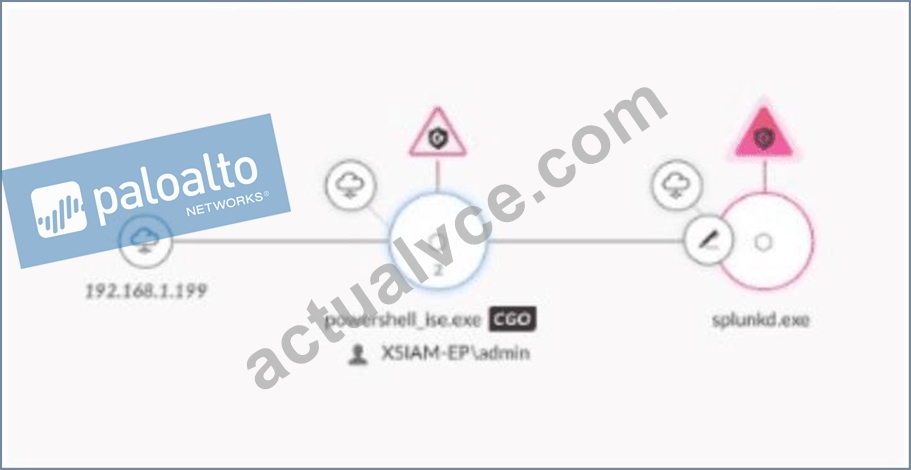
- A. Block 192.168.1.199.
- B. Reboot the machine.
- C. Isolate the affected workstation.
- D. Live Terminal into the workstation to verify.
Answer: A,C
Explanation:
Comprehensive and Detailed Explanation From Exact Extract:
The correct answers areC - Block 192.168.1.199andD - Isolate the affected workstation.
* Block 192.168.1.199:The image shows that the suspicious or malicious activity originated from this source IP address, making it a potential threat actor or compromised system on the network. Blocking this IP helps prevent further communication or lateral movement from the suspected attacker.
* Isolate the affected workstation:Since suspicious activities (like powershell_ise.exe running as an admin and launching splunkd.exe) are detected, isolating the workstation is a critical containment measure. This action disconnects the endpoint from the network, stopping any ongoing attack, lateral movement, or command-and-control activity, while allowing for forensic investigation.
"Isolating an endpoint and blocking the source IP address are best practices for immediate containment in the event of detected compromise or suspicious activity." Document Reference:XSIAM Analyst ILT Lab Guide.pdf Page:Page 40 (Incident Handling section)
NEW QUESTION # 75
An analyst wants to investigate endpoint behavior related to file operations across multiple devices. Why would they use an XDM in this case?
(Choose two)
Response:
- A. To simplify querying across diverse data types
- B. To access structured endpoint data using a uniform schema
- C. To convert threat intelligence feeds into IOC alerts
- D. To display static dashboards
Answer: A,B
NEW QUESTION # 76
What forensic data is most useful for determining malware persistence on a host?
Response:
- A. Parent process tree
- B. Auto-start registry entries
- C. DNS queries
- D. Network flows
Answer: B
NEW QUESTION # 77
A team wants to increase priority for alerts involving finance endpoints. Which methods would apply in Cortex XSIAM?
(Choose two)
Response:
- A. Tag finance machines and update custom prioritization rule
- B. Use user behavior analytics to override scores
- C. Define custom incident scoring rule based on device group
- D. Enable auto-remediation in playbooks
Answer: A,C
NEW QUESTION # 78
What is the role of importing indicators into Cortex XSIAM?
Response:
- A. To reset alert policies
- B. To automate endpoint isolation
- C. To update firewall firmware
- D. To enrich investigations with external threat data
Answer: D
NEW QUESTION # 79
Which verdict values can an artifact have in Cortex XSIAM?
Response:
- A. High, Medium, Low
- B. Unknown, Benign, Malicious
- C. Allow, Deny
- D. Alerted, Blocked, Quarantined
Answer: B
NEW QUESTION # 80
Match alert handling techniques with their description:
Technique
A) Alert Grouping
B) Data Stitching
C) Context Linking
Description
1. Combines similar alerts into a single incident
2. Links alerts using shared entities like IP/user
3. Presents connected data for triage and enrichment
Response:
- A. A-3, B-2, C-1
- B. A-2, B-1, C-3
- C. A-1, B-3, C-2
- D. A-1, B-2, C-3
Answer: D
NEW QUESTION # 81
Why would an analyst schedule an XQL query?
- A. To retrieve data either at specific intervals or at a specified time
- B. To increase accuracy of queries during off-peak load times
- C. To trigger endpoint isolation action
- D. To auto-resolve a false positive alert
Answer: A
Explanation:
The correct answer isB - To retrieve data either at specific intervals or at a specified time.
Scheduling XQL queries allows analysts and teams toautomate the retrieval of data at regular intervals or specific times(such as daily, hourly, or during set windows), supporting reporting, monitoring, and automation workflows without requiring manual intervention.
"Analysts can schedule XQL queries to automatically retrieve data or generate reports at regular intervals or specified times." Document Reference:EDU-270c-10-lab-guide_02.docx (1).pdf Page:Page 25 (Data Analysis with XQL section)
NEW QUESTION # 82
A security analyst reviews two alerts:
- Alert A was triggered by a suspicious process execution pattern across multiple endpoints.
- Alert B was triggered by the presence of a known malicious hash in network traffic.
Which are true regarding these alerts?
(Choose two)
Response:
- A. Alert B is likely an IOC alert
- B. Alert A demonstrates behavioral linkage
- C. Alert A is likely a correlation rule alert
- D. Alert B is likely a BIOC alert
Answer: A,C
NEW QUESTION # 83
What is the cause when alerts generated by a correlation rule are not creating an incident?
- A. The rule is configured with alert severity below Medium.
- B. The rule does not have a drill-down query configured
- C. The rule is using the preconfigured Cortex XSIAM alert field mapping.
- D. The rule has alert suppression enabled
Answer: A
Explanation:
The correct answer isA - The rule is configured with alert severity below Medium.
By default, in Cortex XSIAM,only alerts with a severity of Medium or higher will automatically generate incidents. If a correlation rule creates alerts with severity set below Medium (such as Low or Informational), these alerts willnotresult in the automatic creation of an incident. This ensures that incident queues are not filled with low-priority events.
"Incidents are generated only for alerts with severity of Medium or higher. Alerts below this threshold will not automatically create incidents." Document Reference:XSIAM Analyst ILT Lab Guide.pdf Page:Page 28 (Alerting and Detection section)
NEW QUESTION # 84
......
XSIAM-Analyst Study Guide Realistic Verified Dumps: https://learningtree.actualvce.com/Palo-Alto-Networks/XSIAM-Analyst-valid-vce-dumps.html