

Aruba ACNSA HPE6-A78 Real Exam Questions and Answers FREE Updated on Dec 12, 2025
HPE6-A78 Ultimate Study Guide - ActualVCE
NEW QUESTION # 32
What is one of the roles of the network access server (NAS) in the AAA framewonx?
- A. It negotiates with each user's device to determine which EAP method is used for authentication
- B. It authenticates legitimate users and uses policies to determine which resources each user is allowed to access.
- C. It enforces access to network services and sends accounting information to the AAA server
- D. It determines which resources authenticated users are allowed to access and monitors each users session
Answer: C
Explanation:
In the AAA (Authentication, Authorization, and Accounting) framework, the role of the Network Access Server (NAS) is to act as a gateway that enforces access to network services and sends accounting information to the AAA server. The NAS initially requests authentication information from the user and then passes that information to the AAA server. It also enforces the access policies as provided by the AAA server after authentication and provides accounting data to the AAA server based on user activity.
References:
Technical literature on AAA protocols which often includes a description of the roles and responsibilities of a Network Access Server.
Network security resources that discuss the NAS function within the AAA framework.
NEW QUESTION # 33
You need to deploy an Aruba instant AP where users can physically reach It. What are two recommended options for enhancing security for management access to the AP? (Select two )
- A. install a CA-signed certificate
- B. Place a Tamper Evident Label (TELS) over its console port
- C. Disable Its console ports
- D. Disable the Web Ul.
- E. Configure WPA3-Enterpnse security on the AP
Answer: A,D
Explanation:
When deploying an Aruba Instant AP in a location where users can physically access it, enhancing security for management access could involve several measures: C. Disabling the Web UI will prevent unauthorized access via the browser-based management interface, which could be a security risk if the AP is within physical reach of untrusted parties. E. Installing a CA-signed certificate helps ensure that any communication with the AP's management interface is encrypted and authenticated, preventing man-in-the-middle attacks and eavesdropping.
NEW QUESTION # 34
What is a Key feature of me ArubaOS firewall?
- A. The firewall is designed to fitter traffic primarily based on wireless 802.11 headers, making it ideal for mobility environments
- B. The firewall examines all traffic at Layer 2 through Layer 4 and uses source IP addresses as the primary way to determine how to control traffic.
- C. The firewall is stateful which means that n can track client sessions and automatically allow return traffic for permitted sessions
- D. The firewall Includes application layer gateways (ALGs). which it uses to filter Web traffic based on the reputation of the destination web site.
Answer: D
NEW QUESTION # 35
What is a consideration for using MAC authentication (MAC-Auth) to secure a wired or wireless connection?
- A. MAC-Auth can add a degree of security to an open WLAN by enabling the generation of a PMK to encrypt traffic.
- B. Headless devices, such as Internet of Things (loT) devices, must be configured in advance to support MAC-Auth.
- C. As a Layer 2 authentication method, MAC-Auth cannot be used to authenticate devices to an external authentication server.
- D. It is very easy for hackers to spoof their MAC addresses and get around MAC authentication.
Answer: D
Explanation:
MAC authentication, also known as MAC-Auth, is a method used to authenticate devices based on their Media Access Control (MAC) address. It is often employed in both wired and wireless networks to grant network access based solely on the MAC address of a device. While MAC-Auth is straightforward and doesn't require complex configuration, it has significant security limitations primarily because MAC addresses can be easily spoofed. Attackers can change the MAC address of their device to match an authorized one, thereby gaining unauthorized access to the network. This susceptibility to MAC address spoofing makes MAC-Auth a weaker security mechanism compared to more robust authentication methods like 802.1X, which involves mutual authentication and encryption protocols.
NEW QUESTION # 36
What is a guideline for deploying Aruba ClearPass Device Insight?
- A. Make sure that Aruba devices trust the root CA certificate for the ClearPass Device Insight Analyzer's HTTPS certificate.
- B. For companies with multiple sites, deploy a pair of Device Insight Collectors at the HQ or the central data center.
- C. Configure remote mirroring on access layer Aruba switches, using Device Insight Analyzer as the destination IP.
- D. Deploy a Device Insight Collector at every site in the corporate WAN to reduce the impact on WAN links.
Answer: B
Explanation:
For deploying Aruba ClearPass Device Insight effectively, especially in environments with multiple sites, it is recommended to deploy a pair of Device Insight Collectors at the headquarters or the central data center.
This deployment strategy helps in centralizing the data collection and analysis, which simplifies management and enhances performance by reducing the data load on the WAN links connecting different sites.
Centralizing the collectors at a major site or data center allows for better scalability and reliability of the network management system. This configuration also aids in achieving a more consistent and comprehensive monitoring and analysis of the devices across the network, ensuring that the security and management policies are uniformly applied. This recommendation is based on best practices for network architecture design, particularly those discussed in Aruba's deployment guides and network management strategies.
NEW QUESTION # 37
What is a benefit of Opportunistic Wireless Encryption (OWE)?
- A. It allows both WPA2-capabie and WPA3-capable clients to authenticate to the same WPA-Personal WLAN
- B. It provides protection for wireless clients against both honeypot APs and man-in-the-middle (MUM) attacks
- C. It offers more control over who can connect to the wireless network when compared with WPA2-Personal
- D. It allows anyone lo connect, but provides better protection against eavesdropping than a traditional open network
Answer: D
NEW QUESTION # 38
What is a benefit of Opportunistic Wireless Encryption (OWE)?
- A. It allows anyone to connect, but provides better protection against eavesdropping than a traditional open network.
- B. It offers more control over who can connect to the wireless network when compared with WPA2-Personal.
- C. It provides protection for wireless clients against both honeypot APs and man-in-the-middle (MITM) attacks.
- D. It allows both WPA2-capable and WPA3-capable clients to authenticate to the same WPA-Personal WLAN.
Answer: A
Explanation:
Opportunistic Wireless Encryption (OWE) is a WPA3 feature designed for open wireless networks, where no password or authentication is required to connect. OWE enhances security by providing encryption for devices that support it, without requiring a pre-shared key (PSK) or 802.1X authentication.
Option C, "It allows anyone to connect, but provides better protection against eavesdropping than a traditional open network," is correct. In a traditional open network (no encryption), all traffic is sent in plaintext, making it vulnerable to eavesdropping. OWE allows anyone to connect (as it's an open network), but it negotiates unique encryption keys for each client using a Diffie-Hellman key exchange. This ensures that client traffic is encrypted with AES (e.g., using AES-GCMP), protecting it from eavesdropping. OWE in transition mode also supports non-OWE devices, which connect without encryption, but OWE-capable devices benefit from the added security.
Option A, "It allows both WPA2-capable and WPA3-capable clients to authenticate to the same WPA-Personal WLAN," is incorrect. OWE is for open networks, not WPA-Personal (which uses a PSK). WPA2/WPA3 transition mode (not OWE) allows both WPA2 and WPA3 clients to connect to the same WPA-Personal WLAN.
Option B, "It offers more control over who can connect to the wireless network when compared with WPA2-Personal," is incorrect. OWE is an open network protocol, meaning it offers less control over who can connect compared to WPA2-Personal, which requires a PSK for access.
Option D, "It provides protection for wireless clients against both honeypot APs and man-in-the-middle (MITM) attacks," is incorrect. OWE provides encryption to prevent eavesdropping, but it does not protect against honeypot APs (rogue APs broadcasting the same SSID) or MITM attacks, as it lacks authentication mechanisms to verify the AP's identity. Protection against such attacks requires 802.1X authentication (e.g., WPA3-Enterprise) or other security measures.
The HPE Aruba Networking AOS-8 8.11 User Guide states:
"Opportunistic Wireless Encryption (OWE) is a WPA3 feature for open networks that allows anyone to connect without a password, but provides better protection against eavesdropping than a traditional open network. OWE uses a Diffie-Hellman key exchange to negotiate unique encryption keys for each client, ensuring that traffic is encrypted with AES-GCMP and protected from unauthorized interception." (Page 290, OWE Overview Section) Additionally, the HPE Aruba Networking Wireless Security Guide notes:
"OWE enhances security for open WLANs by providing encryption without requiring authentication. It allows any device to connect, but OWE-capable devices benefit from encrypted traffic, offering better protection against eavesdropping compared to a traditional open network where all traffic is sent in plaintext." (Page 35, OWE Benefits Section)
:
HPE Aruba Networking AOS-8 8.11 User Guide, OWE Overview Section, Page 290.
HPE Aruba Networking Wireless Security Guide, OWE Benefits Section, Page 35.
NEW QUESTION # 39
An MC has a WLAN that enforces WPA3-Enterprise with authentication to HPE Aruba Networking ClearPass Policy Manager (CPPM). The WLAN's default role is set to guest. A Mobility Controller (MC) has these roles configured on it:
authenticated
denyall
guest
general-access
guest-logon
logon
stateful-dot1x
switch-logon
voice
A client authenticates. CPPM returns an Access-Accept with an Aruba-User-Role VSA set to general_access. What role does the client receive?
- A. general-access
- B. authenticated
- C. logon
- D. guest
Answer: A
Explanation:
In an AOS-8 Mobility Controller (MC) environment, a WLAN is configured with WPA3-Enterprise security, using HPE Aruba Networking ClearPass Policy Manager (CPPM) for authentication. The WLAN's default role is set to "guest," which would be applied if no specific role is assigned after authentication. The MC has several roles configured, including "general-access" (note the underscore in the question : "general
_access").
The client successfully authenticates, and CPPM sends an Access-Accept message with an Aruba-User-Role Vendor-Specific Attribute (VSA) set to "general_access." In AOS-8, the Aruba-User-Role VSA is used to assign a specific role to the client, overriding the default role configured on the WLAN. The role specified in the VSA must match a role that exists on the MC. Since "general-access" (or "general_access" as written in the question) is listed among the roles configured on the MC, the MC will apply this role to the client.
The underscore in "general_access" in the VSA versus the hyphen in "general-access" in the MC's role list is likely a typographical inconsistency in the question. In practice, AOS-8 role names are case-insensitive and typically use hyphens, not underscores, but for the purpose of this question, we assume "general_access" matches "general-access" as the intended role.
Option A, "guest," is incorrect because the guest role is the default 802.1X role for the WLAN, but it is overridden by the Aruba-User-Role VSA specifying "general_access." Option B, "logon," is incorrect because the logon role is typically applied during the authentication process (e.g., to allow access to DNS or RADIUS servers), not after successful authentication when a specific role is assigned.
Option C, "general-access," is correct because the MC applies the role specified in the Aruba-User-Role VSA ("general_access"), which matches the "general-access" role configured on the MC.
Option D, "authenticated," is incorrect because the "authenticated" role is not specified in the VSA, and there is no indication that it is the default role for successful authentication in this scenario.
The HPE Aruba Networking AOS-8 8.11 User Guide states:
"When a client authenticates successfully via 802.1X, the Mobility Controller checks for an Aruba-User-Role VSA in the RADIUS Access-Accept message. If the VSA is present and the specified role exists on the controller, the controller assigns that role to the client, overriding the default 802.1X role configured for the WLAN. For example, if the VSA specifies 'general-access' and this role is configured on the controller, the client will be assigned the 'general-access' role." (Page 305, Role Assignment Section) Additionally, the HPE Aruba Networking ClearPass Policy Manager 6.11 User Guide notes:
"The Aruba-User-Role VSA allows ClearPass to assign a specific role to a client on an Aruba Mobility Controller. The role name sent in the VSA must match a role configured on the controller, and the controller will apply this role to the client session, ignoring the default role for the WLAN." (Page 289, RADIUS Enforcement Section)
:
HPE Aruba Networking AOS-8 8.11 User Guide, Role Assignment Section, Page 305.
HPE Aruba Networking ClearPass Policy Manager 6.11 User Guide, RADIUS Enforcement Section, Page 289.
NEW QUESTION # 40
A company has added a new user group. Users in the group try to connect to the WLAN and receive errors that the connection has no Internet access. The users cannot reach any resources. The first exhibit shows the record for one of the users who cannot connect. The second exhibit shows the role to which the ArubaOS device assigned the user's client.
What is a likely problem?
- A. The clients rejected the server authentication on their side because they do not have the root CA for CPPM's RADIUS/EAP certificate.
- B. The role name that CPPM is sending does not match the role name configured on the Aru-baOS device.
- C. The ArubaOS device does not have the correct RADIUS dictionaries installed on it to under-stand the Aruba-User-Role VSA.
- D. The ArubaOS device has a server derivation rule configured on it that has overridden the role sent by CPPM.
Answer: B
Explanation:
The image indicates that there is an issue with the user role assignment, which is key to network access in ArubaOS. If the user role name sent by CPPM doesn't match any of the roles defined in the ArubaOS, then the user will be assigned a default or incorrect role that does not have the necessary permissions, thus leading to the connection errors and lack of Internet access. Ensuring that the role names are consistent between CPPM and ArubaOS can resolve this issue.
NEW QUESTION # 41
Refer to the exhibit.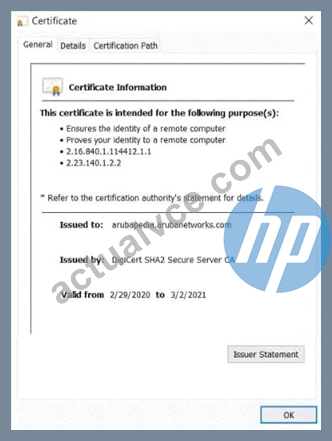
Device A is establishing an HTTPS session with the Arubapedia web sue using Chrome. The Arubapedia web server sends the certificate shown in the exhibit What does the browser do as part of vacating the web server certificate?
- A. It uses the private key in the DigiCert SHA2 Secure Server CA to check the certificate's signature.
- B. It uses the public key in the DigCen SHA2 Secure Server CA certificate to check the certificate's signature.
- C. It uses the public key in the DigCert root CA certificate to check the certificate signature
- D. It uses the private key in the Arubapedia web site's certificate to check that certificate's signature
Answer: B
Explanation:
When a browser, like Chrome, is validating a web server's certificate, it uses the public key in the certificate's signing authority to verify the certificate's digital signature. In the case of the exhibit, the browser would use the public key in the DigiCert SHA2 Secure Server CA certificate to check the signature of the Arubapedia web server's certificate. This process ensures that the certificate was indeed issued by the claimed Certificate Authority (CA) and has not been tampered with.
References:
Browser security documentation and SSL/TLS standards that explain the certificate validation process.
Cybersecurity educational resources that cover the principles of public key infrastructure (PKI) and certificate validation.
NEW QUESTION # 42
What correctly describes the Pairwise Master Key (PMK) in thee specified wireless security protocol?
- A. In WPA3-Personal, the PMK is derived directly from the passphrase and is the same tor every session.
- B. In WPA3-Personal, the PMK is unique per session and derived using Simultaneous Authentication of Equals.
- C. In WPA3-Enterprise, the PMK is unique per session and derived using Simultaneous Authentication of Equals.
- D. In WPA3-Personal, the PMK is the same for each session and is communicated to clients that authenticate
Answer: C
Explanation:
In WPA3-Enterprise, the Pairwise Master Key (PMK) is indeed unique for each session and is derived using a process called Simultaneous Authentication of Equals (SAE). SAE is a new handshake protocol available in WPA3 that provides better security than the Pre-Shared Key (PSK) used in WPA2. This handshake process strengthens user privacy in open networks and provides forward secrecy. The information on SAE and its use in generating a unique PMK can be found in the Wi-Fi Alliance's WPA3 specifications and related technical documentation.
NEW QUESTION # 43
You are configuring ArubaOS-CX switches to tunnel client traffic to an Aruba Mobility Controller (MC).
What should you do to enhance security for control channel communications between the switches and the MC?
- A. install certificates on the switches, and make sure that CPsec is enabled on the MC
- B. Create one UBT zone for control traffic and a second UBT zone for clients.
- C. Make sure that the UBT client vlan is assigned to the interface on which the switches reach the MC and only that interface.
- D. Configure a long, random PAPI security key that matches on the switches and the MC.
Answer: A
NEW QUESTION # 44
You need to set up Aruba network infrastructure devices for management with SNMP. The SNMP server has this SNMPv3 user configured on it: username: airwave auth algorithm: sha auth key: fyluqp18@S!9a priv algorithm: aes priv key: 761oxaiaoeu19& What correctly describes the setup on the infrastructure device?
- A. You must configure a user with the same name and algorithms, but the keys should be unique to this device.
- B. You must configure a user with the same name and keys, but can choose algorithms that meet the device's needs.
- C. You must configure the "airwave" server as an authorized user. Then, configure a separate user for this device with its own keys.
- D. You must configure a user with exactly the same name, algorithms, and keys.
Answer: D
Explanation:
In SNMPv3, security is paramount and each SNMP entity (client or agent) needs to have a user with a security name (username) and optionally, a security level which determines whether authentication and encryption are used. When configuring SNMPv3 users on network infrastructure devices, it is essential to match the username, authentication (auth) algorithm, authentication key (auth key), privacy (priv) algorithm, and privacy key (priv key) exactly as they are configured on the SNMP server to ensure successful communication.
This is because the SNMPv3 security model relies on a combination of a username and a pair of keys (authentication and privacy keys) to uniquely identify and secure communication between the agent and the manager. The keys are used to verify the integrity (auth key) and confidentiality (priv key) of the messages. Using the same algorithms ensures that the messages can be properly encrypted and decrypted on both ends.
NEW QUESTION # 45
What distinguishes a Distributed Denial of Service (DDoS) attack from a traditional Denial or service attack (DoS)?
- A. A DDoS attack targets multiple devices, while a DoS Is designed to Incapacitate only one device
- B. A DDoS attack is launched from multiple devices, while a DoS attack is launched from a single device
- C. A DDoS attack originates from external devices, while a DoS attack originates from internal devices
- D. A DoS attack targets one server, a DDoS attack targets all the clients that use a server
Answer: C
NEW QUESTION # 46
Refer to the exhibit.
A company has an Aruba Instant AP cluster. A Windows 10 client is attempting to connect a WLAN that enforces WPA3-Enterprise with authentication to ClearPass Policy Manager (CPPM). CPPM is configured to require EAP-TLS. The client authentication fails. In the record for this client's authentication attempt on CPPM, you see this alert.
What is one thing that you check to resolve this issue?
- A. whether the client has a third-party 802.1 X supplicant, as Windows 10 does not support EAP-TLS
- B. whether the client has a valid certificate installed on it to let it support EAP-TLS
- C. whether EAP-TLS is enabled in the SSID Profile settings for the WLAN on the IAP cluster
- D. whether EAP-TLS is enabled in the AAA Profile settings for the WLAN on the IAP cluster
Answer: B
Explanation:
In the context of WPA3-Enterprise with EAP-TLS authentication, the error message "Client doesn't support configured EAP methods" suggests that the client is not able to complete the EAP-TLS authentication process. EAP-TLS requires that both the server (in this case, CPPM) and the client have a valid certificate for mutual authentication. Windows 10 does support EAP-TLS natively, so options A, C, and D can be ruled out.
The most likely reason for the authentication failure is that the client device does not have the correct client certificate installed, which is required to establish a TLS session with the server. Therefore, ensuring that the client has a valid certificate installed that matches the server's requirements is the correct step to resolve this issue.
NEW QUESTION # 47
Refer to the exhibit.
You are deploying a new HPE Aruba Networking Mobility Controller (MC), which is enforcing authentication to HPE Aruba Networking ClearPass Policy Manager (CPPM). The authentication is not working correctly, and you find the error shown in the exhibit in the CPPM Event Viewer.
What should you check?
- A. That the IP address that the MC is using to reach CPPM matches the one defined for the device on CPPM
- B. That the shared secret configured for the CPPM authentication server matches the one defined for the device on CPPM
- C. That the MC has valid admin credentials configured on it for logging into the CPPM
- D. That the MC has been added as a domain machine on the Active Directory domain with which CPPM is synchronized
Answer: A
Explanation:
The exhibit shows an error in the CPPM Event Viewer: "RADIUS authentication attempt from unknown NAD 10.1.10.8:1812." This indicates that a new HPE Aruba Networking Mobility Controller (MC) is attempting to send RADIUS authentication requests to HPE Aruba Networking ClearPass Policy Manager (CPPM), but CPPM does not recognize the MC as a Network Access Device (NAD), resulting in the authentication failure.
Unknown NAD Error: In CPPM, a NAD is a device (e.g., an MC, switch, or AP) that sends RADIUS requests to CPPM for authentication. Each NAD must be configured in CPPM with its IP address and a shared secret. The error "unknown NAD 10.1.10.8:1812" means that the IP address 10.1.10.8 (the source IP of the MC's RADIUS request) is not listed as a NAD in CPPM's configuration, so CPPM rejects the request.
Option A, "That the IP address that the MC is using to reach CPPM matches the one defined for the device on CPPM," is correct. You need to check that the MC's IP address (10.1.10.8) is correctly configured as a NAD in CPPM. In CPPM, go to Configuration > Network > Devices, and verify that a NAD entry exists for 10.1.10.8. If the IP address does not match (e.g., due to NAT, a different interface, or a misconfiguration), CPPM will reject the request as coming from an unknown NAD.
Option B, "That the MC has valid admin credentials configured on it for logging into the CPPM," is incorrect. Admin credentials on the MC are used for management access (e.g., SSH, web UI), not for RADIUS authentication. RADIUS communication between the MC and CPPM uses a shared secret, not admin credentials.
Option C, "That the MC has been added as a domain machine on the Active Directory domain with which CPPM is synchronized," is incorrect. Adding the MC as a domain machine in Active Directory (AD) is relevant only if the MC itself is authenticating users against AD (e.g., for machine authentication), but this is not required for the MC to act as a NAD sending RADIUS requests to CPPM.
Option D, "That the shared secret configured for the CPPM authentication server matches the one defined for the device on CPPM," is incorrect in this context. While a shared secret mismatch would cause authentication failures, it would not result in an "unknown NAD" error. The "unknown NAD" error occurs before the shared secret is checked, as CPPM does not recognize the IP address as a valid NAD.
The HPE Aruba Networking ClearPass Policy Manager 6.11 User Guide states:
"The error 'RADIUS authentication attempt from unknown NAD <IP-address>' in the Event Viewer indicates that the IP address of the device sending the RADIUS request (e.g., a Mobility Controller) is not configured as a Network Access Device (NAD) in ClearPass. To resolve this, go to Configuration > Network > Devices in the CPPM UI, and ensure that the IP address of the device (e.g., 10.1.10.8) is added as a NAD with the correct shared secret. The IP address used by the device to reach CPPM must match the one defined in the NAD configuration." (Page 302, Troubleshooting RADIUS Issues Section) Additionally, the HPE Aruba Networking AOS-8 8.11 User Guide notes:
"When configuring a Mobility Controller to use ClearPass as a RADIUS server, ensure that the MC's IP address is added as a NAD in ClearPass. If ClearPass logs an 'unknown NAD' error, verify that the IP address the MC uses to send RADIUS requests (e.g., the source IP of the request) matches the IP address configured in ClearPass under Configuration > Network > Devices." (Page 498, Configuring RADIUS Authentication Section)
:
HPE Aruba Networking ClearPass Policy Manager 6.11 User Guide, Troubleshooting RADIUS Issues Section, Page 302.
HPE Aruba Networking AOS-8 8.11 User Guide, Configuring RADIUS Authentication Section, Page 498.
NEW QUESTION # 48
A company has Aruba Mobility Controllers (MCs), Aruba campus APs, and ArubaOS-CX switches. The company plans to use ClearPass Policy Manager (CPPM) to classify endpoints by type. The company is contemplating the use of ClearPass's TCP fingerprinting capabilities.
What is a consideration for using those capabilities?
- A. ClearPass admins will need to provide the credentials of an API admin account to configure on Aruba devices.
- B. TCP fingerprinting of wireless endpoints requires a third-party Mobility Device Management (MDM) solution.
- C. ArubaOS-CX switches do not offer the support necessary for CPPM to use TCP fingerprinting on wired endpoints.
- D. You will need to mirror traffic to one of CPPM's span ports from a device such as a core routing switch.
Answer: D
Explanation:
ClearPass Policy Manager (CPPM) uses various methods to classify endpoints, and one of them is TCP fingerprinting, which involves analyzing TCP/IP packets to identify the type of device or operating system sending them. To utilize TCP fingerprinting capabilities, network traffic needs to be accessible to the CPPM.
This can be done by mirroring traffic to CPPM's span port from a device that can see the traffic, like a core routing switch. This approach allows CPPM to observe the TCP characteristics of devices as they communicate over the network, enabling it to make more accurate decisions for device classification.
NEW QUESTION # 49
You need to deploy an Aruba instant AP where users can physically reach It. What are two recommended options for enhancing security for management access to the AP? (Select two )
- A. install a CA-signed certificate
- B. Disable Its console ports
- C. Place a Tamper Evident Label (TELS) over its console port
- D. Disable the Web Ul.
- E. Configure WPA3-Enterpnse security on the AP
Answer: A,C
NEW QUESTION # 50
A customer has an AOS-10 network infrastructure. The customer is looking for a solution that can classify many different types of devices, including IoT devices. Which solution should you explain can provide these capabilities?
- A. HPE Aruba Networking Central
- B. HPE Aruba Networking ClearPass Onboard
- C. HPE Aruba Networking ClearPass OnGuard
- D. HPE Aruba Networking EdgeConnect SD-WAN
Answer: C
Explanation:
HPE Aruba Networking ClearPass OnGuard: This is a component of the ClearPass Policy Manager platform specifically designed for endpoint posture assessment and health checks. It can identify and classify a wide range of devices connecting to the network, including traditional endpoints, mobile devices, and importantly, IoT devices. It analyzes device attributes and behaviors to determine their type and security posture.
Let's look at why the other options are less suitable for this specific requirement:
HPE Aruba Networking EdgeConnect SD-WAN: This solution focuses on optimizing wide area network (WAN) connectivity, improving application performance, and providing secure branch-to-branch and branch-to-cloud connections. While it can identify traffic from different devices, its primary function isn't detailed device classification at the network access layer.
HPE Aruba Networking Central: This is a cloud-based network management platform that provides visibility, configuration, and management for Aruba network devices (APs, switches, gateways). While it offers insights into connected devices, its core function isn't the deep classification of diverse endpoint types like IoT devices.
HPE Aruba Networking ClearPass Onboard: This component of ClearPass Policy Manager focuses on simplifying the secure onboarding of personal or unmanaged devices (BYOD). While it involves device identification during the onboarding process, its primary goal isn't continuous and comprehensive classification of all device types, especially the detailed classification needed for diverse IoT devices.
Therefore, HPE Aruba Networking ClearPass OnGuard is the most appropriate solution for classifying a wide range of devices, including IoT devices, within an AOS-10 network infrastructure.
NEW QUESTION # 51
What is a correct guideline for the management protocols that you should use on AOS-CX switches?
- A. Make sure that SSH is disabled and use HTTPS instead.
- B. Make sure that HTTPS is disabled and use SSH instead.
- C. Make sure that Telnet is disabled and use TFTP instead.
- D. Make sure that Telnet is disabled and use SSH instead.
Answer: D
Explanation:
AOS-CX switches support various management protocols for administrative access, such as SSH, Telnet, HTTPS, and TFTP. Security best practices for managing network devices, including AOS-CX switches, emphasize using secure protocols to protect management traffic from eavesdropping and unauthorized access.
Option B, "Make sure that Telnet is disabled and use SSH instead," is correct. Telnet is an insecure protocol because it sends all data, including credentials, in plaintext, making it vulnerable to eavesdropping. SSH (Secure Shell) provides encrypted communication for remote management, ensuring that credentials and commands are protected. HPE Aruba Networking recommends disabling Telnet and enabling SSH for secure management access on AOS-CX switches.
Option A, "Make sure that SSH is disabled and use HTTPS instead," is incorrect. SSH and HTTPS serve different purposes: SSH is for CLI access, while HTTPS is for web-based management. Disabling SSH would prevent secure CLI access, which is not a recommended practice. Both SSH and HTTPS should be enabled for secure management.
Option C, "Make sure that Telnet is disabled and use TFTP instead," is incorrect. TFTP (Trivial File Transfer Protocol) is used for file transfers (e.g., firmware updates), not for management access like Telnet or SSH. TFTP is also insecure (no encryption), so it's not a suitable replacement for Telnet.
Option D, "Make sure that HTTPS is disabled and use SSH instead," is incorrect. HTTPS is used for secure web-based management and should not be disabled. Both HTTPS and SSH are secure protocols and should be used together for different management interfaces (web and CLI, respectively).
The HPE Aruba Networking AOS-CX 10.12 Security Guide states:
"For secure management of AOS-CX switches, disable insecure protocols like Telnet, which sends data in plaintext, and use SSH instead. SSH provides encrypted communication for CLI access, protecting credentials and commands from eavesdropping. Use the command no telnet-server to disable Telnet and ssh-server to enable SSH. Additionally, enable HTTPS for web-based management with https-server to ensure all management traffic is encrypted." (Page 195, Secure Management Protocols Section) Additionally, the HPE Aruba Networking Security Best Practices Guide notes:
"A key guideline for managing AOS-CX switches is to disable Telnet and enable SSH for CLI access. Telnet is insecure and should not be used in production environments, as it transmits credentials in plaintext. SSH ensures secure remote management, and HTTPS should also be enabled for web access." (Page 25, Management Security Section)
:
HPE Aruba Networking AOS-CX 10.12 Security Guide, Secure Management Protocols Section, Page 195.
HPE Aruba Networking Security Best Practices Guide, Management Security Section, Page 25.
NEW QUESTION # 52
......
Ultimate Guide to Prepare HPE6-A78 Certification Exam for Aruba ACNSA: https://learningtree.actualvce.com/HP/HPE6-A78-valid-vce-dumps.html