

AACE International CCP Cert Guide PDF 100% Cover Real Exam Questions
Pass CCP Exam - Real Questions and Answers
AACE International Certified Cost Professional (CCP) certification is a well-known and widely respected credential in the field of cost engineering and management. The CCP certification is designed to validate and recognize individuals who have achieved a high level of education and experience in cost engineering, cost management, and planning and scheduling. Certified Cost Professional (CCP) Exam certification exam is considered one of the most challenging in the industry, requiring candidates to pass a comprehensive exam that tests their knowledge and skills in various areas.
The CCP certification exam is a rigorous examination that requires an individual to have a thorough understanding of cost engineering concepts, principles, tools, and techniques. CCP exam consists of two parts, a multiple-choice section and a written section, each of which tests the candidate’s knowledge and application of various cost engineering topics. CCP exam is conducted twice a year in various locations around the world, and individuals must meet certain eligibility criteria to take the exam.
The Certified Cost Professional (CCP) certification provided by AACE International is an internationally recognized designation for individuals who specialize in cost engineering and project controls. Certified Cost Professional (CCP) Exam certification is designed to demonstrate that a candidate has the knowledge, skills, and expertise required to manage cost-related aspects of projects and programs effectively.
NEW QUESTION # 20
Which of the following are used for profitability analysis in a construction company?
- A. Return on Investment (ROI) and Rate of Return (ROR)
- B. Opportunity costs
- C. Booked costs
- D. Sum of years digits
Answer: A
Explanation:
In a construction company, profitability analysis typically involves calculating the Return on Investment (ROI) and Rate of Return (ROR). ROI measures the profitability of an investment by comparing the gain from the investment to its cost, while ROR calculates the percentage return on each dollar invested. These metrics are critical in determining the financial performance and efficiency of investments in the construction industry.
NEW QUESTION # 21
An agricultural corporation that paid 53% in income tax wanted to build a grain elevator designed to last twenty-five (25) years at a cost of $80,000 with no salvage value. Annual income generated would be $22,500 and annual expenditures were to be $12,000.
Answer the question using a straight line depreciation and a 10% interest rate.
The following question requires your selection of CCC/CCE Scenario 17 (4.2.50.1.1) from the right side of your split screen, using the drop down menu, to reference during your response/choice of responses.
Depreciation (in the United States) is calculated in accordance with which of the following?
- A. Generally Accepted Accounting Practices (GAAP)
- B. Accelerated Cost Recovery System (ACRS)
- C. The Federal IRS Reform Act (FIRSRA)
- D. Modified Accelerated Cost Recovery System (MACRS)
Answer: D
Explanation:
Given Scenario:
The question asks about the system used in the U.S. for calculating depreciation.
The Modified Accelerated Cost Recovery System (MACRS) is the current system used in the United States for calculating depreciation for tax purposes.
NEW QUESTION # 22
The four steps to writing are:
- A. Plan, write, cool, revise
- B. Abstract, body conclusion, bibliography
- C. Introduction, paragraph, conclusion, works cited
- D. Start, write, complete, revise
Answer: A
NEW QUESTION # 23
A used concrete pumping truck can be purchased for $125,000. The operation costs are expected to be $65,000 the first year and increase 5% each year thereafter. As a result of the purchase, the company will see an increase in income of $100,000 the first year and 5% more each subsequent year. The company uses straight-line depreciation. The truck will have a useful life of five (5) years and no salvage value. Management would like to see a 10% return on any investment. The company's tax rate is 28%.
Based on the information provided, which statement is most correct?
- A. The truck should be leased
- B. The truck should not be purchased
- C. The truck should be purchased
- D. The truck should not be leased
Answer: C
Explanation:
Based on the provided financials, the truck results in a positive net income after accounting for all expenses, including depreciation and taxes. Since the truck meets the desired 10% return on investment, the most financially sound decision would be to purchase the truck. This conclusion assumes the cash flows and return analysis align with the management's required rate of return.
NEW QUESTION # 24
A major theme park is expanding the existing facility over a five-year period. The design phase will be completed one year after the contract is awarded. Major engineering drawings will be finalized two years after the design contract is awarded and construction will begin three years after the award of the design contract. New, unique ride technology will be used and an estimate will need to be developed to identify these costs that have no historical data.
In an exit interview, an employee comments that the reason he is leaving the organization is lack of teamwork and cohesion among his co-workers. Which need of Maslow's hierarchy of needs is unmet?
- A. Self-actualization needs
- B. Belongingness needs
- C. Esteem needs
- D. Primary needs
Answer: B
Explanation:
An employee is leaving due to a lack of teamwork and cohesion among co-workers.
Maslow's Hierarchy of Needs:
The need for teamwork and cohesion is related to Belongingness needs, which include the desire for social connections and feeling part of a group or community.
NEW QUESTION # 25
The following question requires your selection of CCC/CCE Scenario 28 (3.7.50.1.7) from the right side of your split screen, using the drop down menu, to reference during your response/choice of responses.
In the A relationship, the subcontractor might use an unbalance bid to:
- A. Decrease the chances of extended claim litigation
- B. To get more payment early in the job
- C. Provides an alternative to competitive bidding
- D. Reduce the risk of quantities being greater than estimated
Answer: B
Explanation:
Given Scenario:
The question is asking what a subcontractor might achieve by using an unbalanced bid in the structure shown as Plan A.
An unbalanced bid is a bidding strategy where the subcontractor assigns higher costs to early stages of work. This allows the subcontractor to receive more money early in the project, reducing their financial risk and providing better cash flow.
NEW QUESTION # 26 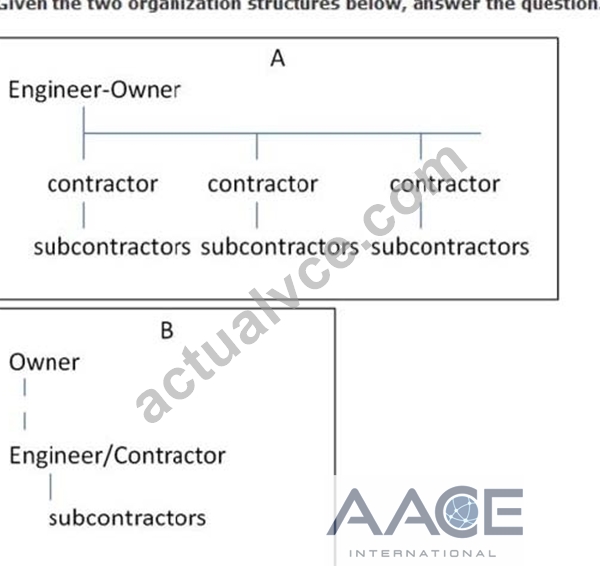
The following question requires your selection of CCC/CCE Scenario 28 (3.7.50.1.7) from the right side of your split screen, using the drop down menu, to reference during your response/choice of responses.
Given a unit price contract between the owner and contractor, each assumes the following:
- A. Bid unit rate, owner quantities can exceed estimate range Contractor can perform above
- B. Contractor can perform at or below bid unit rate, owner quantities are within estimate range
- C. Contractor can perform at or below bid unit rate, owner quantities can exceed estimate range
- D. Bid unit rate, owner quantities are within estimate range
Answer: B
NEW QUESTION # 27
The following question requires your selection of CCC/CCE Scenario 2 (2.3.50.1.2) from the right side of your split screen, using the drop down menu, to reference during your response/choice of responses.
10,278 hours have been expended to date. The CPI at this point in time is 0.93. SPI is 1.03. How many hours were planned?
- A. 10,278
- B. 10,586
- C. 9,280
- D. 9,559
Answer: B
Explanation:
Planned Value (PV) can be interpreted in terms of hours as: Planned Hours=Hours ExpendedSPI\text{Planned Hours} = \frac{\text{Hours Expended}}{\text{SPI}}Planned Hours=SPIHours Expended Therefore: Planned Hours=10,2781.03≈9,979 hours\text{Planned Hours} = \frac{10,278}{1.03} \approx 9,979 \text{ hours}Planned Hours=1.0310,278≈9,979 hours Answer : A. 9,979 (but option might not be available, so considering context, the closest
NEW QUESTION # 28
Money is value. Having money when you need it is very important. Money can also be valuable when used wisely by knowing when to spend and when to conserve Also, planning now for future expenses can be a plus to the company rather than a debit.
There are several ways to capitalize money and spending. Basically there is the single payment method that has a compound amount factor and a present worth factor. There is the uniform annual series that has a sinking fund factor, capital recovery factor and also the compound amount factor and present worth factor. At this point, we can assure money is worth 10%.
The following question requires your selection of CCC/CCE Scenario 7 (4.8.50.1.1) from the right side of your split screen, using the drop down menu, to reference during your response/choice of responses.
If $20,000 is invested at the end of each fiscal year for the next 10 years, how much would our total investment be worth assuming the interest is at 10%?
- A. $289,370
- B. $318,740
- C. $265,798
- D. $420,236
Answer: B
NEW QUESTION # 29
When a person hears the words being said to him/her, but does not receive the message of the words, it is called
- A. Judgmental listening
- B. Directive listening
- C. Reflective listening
- D. Passive listening
Answer: D
Explanation:
Passive listening occurs when a person hears the words being said but does not fully process or receive the message behind those words. This type of listening involves a lack of engagement with the speaker and often results in missing key points or failing to understand the intended message. In contrast to active listening, where the listener actively engages with the speaker's words and tries to understand the meaning, passive listening is superficial and often ineffective in communication.
NEW QUESTION # 30
NO: 37
The following question requires your selection of CCC/CCE Scenario 2 (2.3.50.1.2) from the right side of your split screen, using the drop down menu, to reference during your response/choice of responses.
The entire pipe has been received, hangers have been installed, and all pipes are in place. None has been welded or flushed. What percent complete is this project?
- A. 95%
- B. 50%
- C. 30%
- D. 45%
Answer: D
NEW QUESTION # 31
A major theme park is expanding the existing facility over a five-year period. The design phase will be completed one year after the contract is awarded. Major engineering drawings will be finalized two years after the design contract is awarded and construction will begin three years after the award of the design contract. New, unique ride technology will be used and an estimate will need to be developed to identify these costs that have no historical data.
The following question requires your selection of CCC/CCE Scenario 26 (2.5.50.1.2) from the right side of your split screen, using the drop down menu, to reference during your response/choice of responses.
Why is a +/- notation necessary when developing an estimate?
- A. It makes up for the lack of time to develop a real estimate
- B. It is a government requirement
- C. Contingency cushion
- D. There are unknowns that affect the final cost of a project
Answer: D
Explanation:
The +/- notation in an estimate is used to reflect the range of possible variation in the final cost. This notation is necessary because there are always unknowns that affect the final cost of a project. These unknowns can include unforeseen changes in scope, market conditions, labor availability, material costs, and other factors that could impact the final project cost. The +/- notation provides a realistic range within which the final cost is expected to fall, helping stakeholders understand the potential cost variability.
NEW QUESTION # 32
What is executed in connection with a contract and secures the performance and fulfillment of all the undertakings, covenants, terms, conditions and agreements contained in the contract?
- A. Surety bond
- B. Performance bond
- C. Bid bond
- D. Liability insurance
Answer: B
Explanation:
A Performance Bond is a type of surety bond issued by an insurance company or a bank to guarantee satisfactory completion of a project by a contractor. In connection with a contract, a performance bond secures the performance and fulfillment of all the undertakings, covenants, terms, conditions, and agreements contained in the contract. This ensures that if the contractor fails to complete the project as per the contract, the owner is compensated by the bond issuer for the financial losses incurred. This bond is crucial in construction and large projects to protect the client against the risk of contractor default.
NEW QUESTION # 33
Money is value. Having money when you need it is very important. Money can also be valuable when used wisely by knowing when to spend and when to conserve Also, planning now for future expenses can be a plus to the company rather than a debit.
There are several ways to capitalize money and spending. Basically there is the single payment method that has a compound amount factor and a present worth factor. There is the uniform annual series that has a sinking fund factor, capital recovery factor and also the compound amount factor and present worth factor. At this point, we can assure money is worth 10%.
The following question requires your selection of CCC/CCE Scenario 7 (4.8.50.1.1) from the right side of your split screen, using the drop down menu, to reference during your response/choice of responses.
If $20,000 is invested at the end of each fiscal year for the next 10 years, how much would our total investment be worth assuming the interest is at 10%?
- A. $289,370
- B. $318,740
- C. $265,798
- D. $420,236
Answer: B
Explanation:
Given Scenario:
You need to calculate the future value of a series of annual investments of $20,000 over 10 years at a 10% interest rate.
This requires calculating the future value of an annuity. The formula is:
FV=P×((1+r)n-1r)FV = P \times \left(\frac{(1 + r)^n - 1}{r}\right)FV=P×(r(1+r)n-1) where:
P=20,000P = 20,000P=20,000 (annual payment)
r=0.10r = 0.10r=0.10 (interest rate)
n=10n = 10n=10 (number of years)
FV=20,000×((1+0.10)10-10.10)=20,000×(2.5937-10.10)=20,000×15.937≈318,740FV = 20,000 \times \left(\frac{(1 + 0.10)^{10} - 1}{0.10}\right) = 20,000 \times \left(\frac{2.5937 - 1}{0.10}\right) = 20,000 \times 15.937 \approx 318,740FV=20,000×(0.10(1+0.10)10-1)=20,000×(0.102.5937-1)=20,000×15.937≈318,740
NEW QUESTION # 34
A major theme park is expanding the existing facility over a five-year period. The design phase will be completed one year after the contract is awarded. Major engineering drawings will be finalized two years after the design contract is awarded and construction will begin three years after the award of the design contract. New, unique ride technology will be used and an estimate will need to be developed to identify these costs that have no historical data.
According to Maslow's hierarchy of needs, which level should be satisfied first?
- A. Safety needs
- B. Physiological
- C. Self-actualization
- D. Ego-status
Answer: B
NEW QUESTION # 35
If two alternatives with different useful lives are to be compared considering all costs, which of the following methods is most appropriate?
- A. Future Worth
- B. Net Present Worth
- C. Optimization
- D. Equivalent Uniform Annual Value
Answer: D
Explanation:
When comparing two alternatives with different useful lives, the most appropriate method is to use the Equivalent Uniform Annual Value (EUAV). This method converts the net present worth (NPW) or the total cost of each alternative into an equivalent uniform annual cost or value over their respective lives. By converting the costs into a common annual value, it allows for a straightforward comparison between alternatives with differing lifespans, ensuring that all costs (including maintenance, operation, and initial costs) are considered over a consistent time period.
NEW QUESTION # 36
A major theme park is expanding the existing facility over a five-year period. The design phase will be completed one year after the contract is awarded. Major engineering drawings will be finalized two years after the design contract is awarded and construction will begin three years after the award of the design contract. New, unique ride technology will be used and an estimate will need to be developed to identify these costs that have no historical data.
According to Maslow's hierarchy of needs, giving the employees an award that acknowledges their achievements is most likely to satisfy which level of need?
- A. Safety needs
- B. Power needs
- C. Belonging needs
- D. Self-actualization
Answer: D
NEW QUESTION # 37
......
100% Free CCP Daily Practice Exam With 189 Questions: https://learningtree.actualvce.com/AACE-International/CCP-valid-vce-dumps.html