

NSE6_SDW_AD-7.6 PDF Download Jun-2026 Fortinet Test To Gain Brilliante Result!
Provide Updated Fortinet NSE6_SDW_AD-7.6 Dumps as Practice Test and PDF
NEW QUESTION # 14
Refer to the exhibit.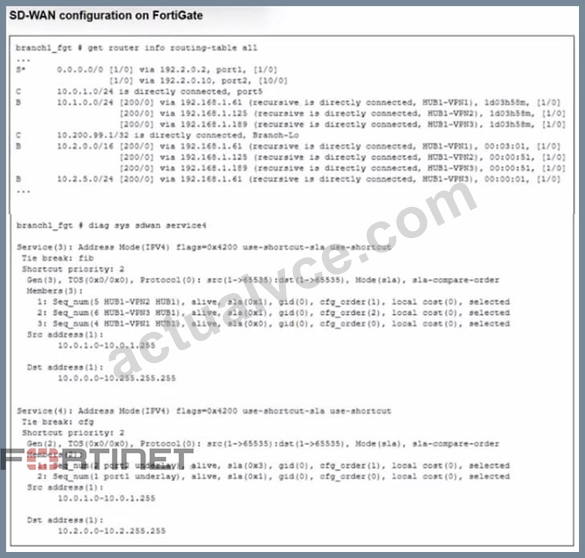
Which SD-WAN rule and interface uses FortiGate to steer the traffic from the LAN subnet 10.0.1.0/24 to the corporate server 10.2.5.254?
- A. SD-WAN service rule 4 and port1 or port2.
- B. SD-WAN service rule 4 and interface port2.
- C. SD-WAN service rule 3 and interface HUB1-VPN2.
- D. SD-WAN service rule 3 and interface HUB1-VPN3.
Answer: B
Explanation:
Traffic steering in Fortinet SD-WAN is based on defined rules and the corresponding outgoing interfaces. The exhibit (not shown here) would indicate that the traffic from the LAN subnet 10.0.1.0/24 to the server
10.2.5.254 is matched by SD-WAN rule 3 and sent out via the HUB1-VPN3 interface.
References:
[FCSS_SDW_AR-7.4 1-0.docx Q2]
FortiOS 7.4 SD-WAN Concept Guide - Rule Matching
NEW QUESTION # 15
(Refer to the exhibits.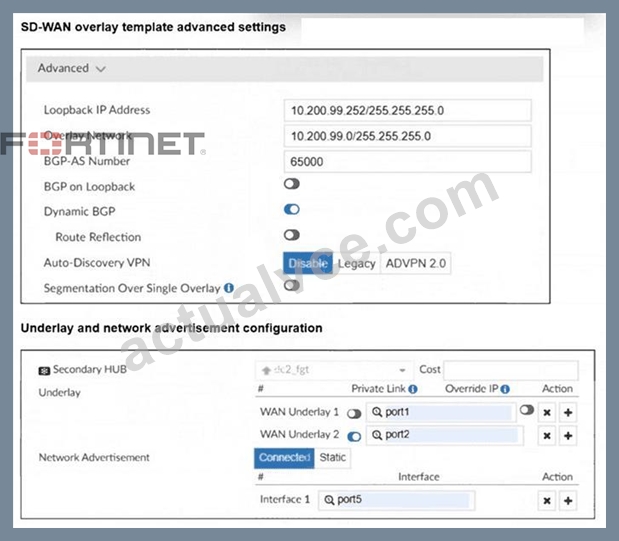
The SD-WAN overlay template advanced settings and the underlay and network advertisement settings are shown. These are the configurations for the secondary hub of a dual-hub SD-WAN topology created with the FortiManager SD-WAN overlay orchestrator.
Which two conclusions can you draw from the information shown in the exhibits? Choose two answers.)
- A. FortiManager will create an overlay tunnel on the port1 interface.
- B. FortiManager will create an overlay tunnel on the port2 interface.
- C. FortiManager will define port5 as a BGP neighbor.
- D. FortiManager will define port2 as a BGP neighbor.
Answer: A,B
Explanation:
From the Underlay and network advertisement configuration exhibit for the Secondary HUB:
* Under Underlay, the template explicitly lists:
* WAN Underlay 1 = port1
* WAN Underlay 2 = port2
In FortiManager SD-WAN Overlay Orchestrator, underlay interfaces selected for a hub are the transports used to build the overlay IPsec tunnels (one overlay per underlay, per peer as defined by the template).
Because both port1 and port2 are configured as underlays, FortiManager will build overlay tunnels over both underlay links. That supports:
* Option C (overlay tunnel on port1)
* Option B (overlay tunnel on port2)
For the BGP neighbor options:
* The Network Advertisement section shows Interface 1 = port5, which indicates a LAN/internal interface whose connected or static networks may be advertised into the overlay routing domain. This does not make port5 a BGP neighbor interface; it is the interface whose routes are being advertised.
* The template indicates Dynamic BGP is enabled. In Overlay Orchestrator designs, BGP neighbor relationships are formed across the overlay tunnel interfaces / overlay endpoints, not directly on the raw underlay interfaces (port1/port2) and not on the advertised LAN interface (port5). Therefore, options A and D are not valid conclusions from what is shown.
So, the two correct conclusions are B and C.
NEW QUESTION # 16
(You are using the FortiManager SD-WAN monitor menus to check the status of an SD-WAN topology.
When you place the mouse next to branch1_fgt, you receive the output shown in the exhibit.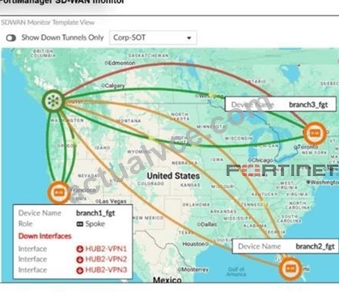
Which two conclusions can you draw from the output shown in the exhibit? Choose two answers.)
- A. Three spokes have tunnels that are out of SLA.
- B. The template Corp-SOT defines a dual-hub topology.
- C. branch1_fgt is configured with six SD-WAN overlay tunnels and three are down.
- D. branch3_fgt is configured with three SD-WAN overlay tunnels and one is down.
Answer: A,D
NEW QUESTION # 17
As an MSSP administrator, you are asked to configure ADVPN on an existing SD-WAN topology.
FortiManager manages the customer devices in a dedicated ADOM. The previous administrator used the SD- WAN overlay topology.
Which two statements apply to this scenario? (Choose two.)
- A. After you enable auto-discovery VPN in the overlay template, you must select between ADVPN 2.0 and ADVPN 1.0.
- B. When auto-discovery VPN is enabled, FortiManager updates the IPsec and BGP templates in the hub.
- C. You can activate auto-discovery VPN in the SD-WAN overlay template only if it is a single hub topology.
- D. You can activate auto-discovery VPN in the SD-WAN overlay template for any type of topology, including a primary-primary dual-hub topology.
Answer: B,D
Explanation:
When you enable ADVPN (auto-discovery VPN) in the overlay template, FortiManager automatically updates both the IPsec and BGP templates on the hub so that shortcut tunnels can be established dynamically.
ADVPN can be activated in the SD-WAN overlay template for any supported topology, including dual-hub primary-primary, not just single hub.
NEW QUESTION # 18
(In which order does FortiGate consider the following elements during the route lookup process? Choose one answer.)
- A. Policy routes, SD-WAN rules, Internet Service Database (ISDB) routes, BGP routes
- B. SD-WAN rules, ISDB routes, policy routes, BGP routes
- C. SD-WAN rules, policy routes, static routes, ISDB routes
- D. Policy routes, ISDB routes, SD-WAN rules, static routes
Answer: D
Explanation:
In FortiOS (including FortiOS 7.6), FortiGate follows a strict and well-defined route lookup order when determining how to forward traffic. This order is critical for understanding SD-WAN behavior and is explicitly referenced in the FCSS SD-WAN curriculum.
The correct lookup sequence is:
* Policy routes (Policy-Based Routing)Policy routes are evaluated first. If traffic matches a policy route, FortiGate immediately forwards the traffic according to that policy and bypasses all other routing mechanisms.
* Internet Service Database (ISDB) routesIf no policy route matches, FortiGate checks ISDB routes.
These routes match traffic based on Internet Services rather than destination IP prefixes.
* SD-WAN rulesIf neither a policy route nor an ISDB route matches, FortiGate evaluates SD-WAN rules to determine the outgoing interface based on the configured SD-WAN strategy.
* Routing table (connected, static, and dynamic routes such as BGP)If no SD-WAN rule matches, FortiGate performs a normal routing table lookup.
* FIB (Forwarding Information Base)The FIB is used to forward the packet based on the selected route.
* DropIf no valid route exists, the packet is dropped.
Among the options provided, only Option D correctly reflects the beginning of this sequence by placing policy routes first, followed by ISDB routes, then SD-WAN rules, and finally static routes (representing the routing table).
Therefore, the correct answer is D.
NEW QUESTION # 19
(Refer to the exhibit.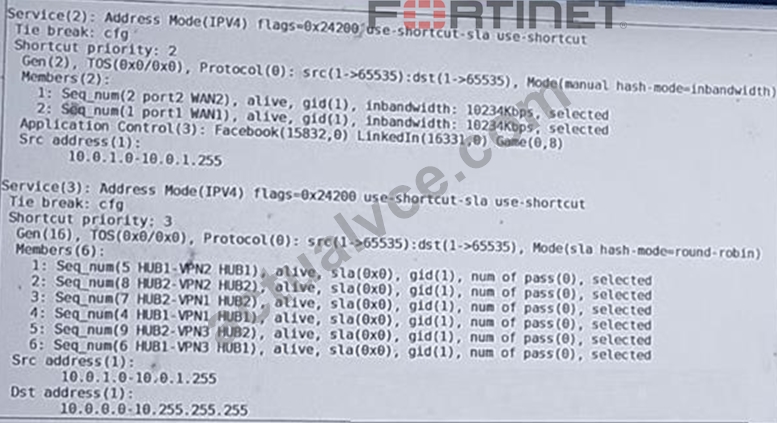
The administrator configured two SD-WAN rules to load balance traffic.
Which interfaces does FortiGate use to steer the traffic from 10.0.1.124 to 10.0.0.254? Choose one answer.)
- A. HUB1-VPN2
- B. FortiGate routes the traffic according to the FIB.
- C. Any interface in the HUB1 or HUB2 zones
- D. port1 or port2
Answer: B
NEW QUESTION # 20
Exhibit.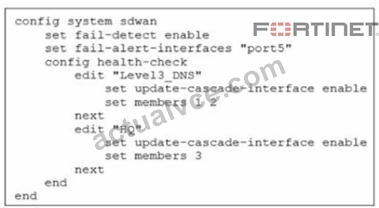
Which action will FortiGate take if it detects SD-WAN members as dead?
- A. FoftiGate bounces port5 after it detects all SD-WAN members as dead.
- B. FortiGate fails over to the secondary device after it detects port5 as dead.
- C. FortiGate brings down port5 after it detects all SD-WAN members as dead.
- D. FortiGate sends alert messages through poft5 when it detects all SD-WAN members as dead
Answer: D
NEW QUESTION # 21
You want FortiGate to use SD-WAN rules to steer local-out traffic.
Which two constraints should you consider? (Choose two.)
- A. You must configure each local-out feature individually to use SD-WAN.
- B. You can steer local-out traffic only with SD-WAN rules that use the manual strategy.
- C. By default, local-out traffic does not use SD-WAN.
- D. By default, FortiGate uses SD-WAN rules only for local-out traffic that corresponds to ping and traceroute.
Answer: A,C
Explanation:
By default, local-out traffic does not use SD-WAN # FortiGate normally sends local-out traffic (e.g., DNS, NTP, FortiGuard updates) directly through its interfaces without applying SD-WAN rules.
You must configure each local-out feature individually to use SD-WAN # To steer local-out traffic via SD- WAN, you must explicitly configure the desired local-out features (e.g., DNS, FortiGuard, CAPWAP) to use SD-WAN rules.
NEW QUESTION # 22
(You are configuring SD-WAN to load balance network traffic and you want to take into account the link quality.
Which two facts should you consider? Choose two answers.)
- A. You can select the lowest cost service level agreement (SLA) strategy and allow SD-WAN load balancing.
- B. The best quality strategy supports only the round-robin hash mode.
- C. When applicable, FortiGate load balances the traffic through all members that meet the SLA target.
- D. You can select the best quality strategy and allow SD-WAN load balancing.
Answer: A,C
Explanation:
When SD-WAN load balancing is required with link quality awareness, FortiOS relies on SLA-based strategies. These strategies evaluate link performance using performance SLAs (latency, jitter, packet loss, MOS) and then make forwarding decisions accordingly.
Option A is correct.
In FortiOS 7.6, when an SLA-based SD-WAN rule has load balancing enabled, FortiGate distributes traffic only across the members that meet the SLA targets. Any member that is out of SLA is excluded from load balancing. This behavior ensures that traffic is not forwarded over degraded links while still allowing load distribution across healthy paths.
Option C is correct.
The lowest cost (SLA) strategy is an SLA-based strategy that considers link quality while also allowing SD- WAN load balancing. When multiple members meet the SLA requirements and have equal cost, FortiGate can load balance traffic across them using the configured hash mode. This makes the lowest cost SLA strategy suitable when both link quality and load balancing are required.
Why the other options are incorrect:
* Option B is incorrect because the best quality strategy is designed to select the single best-performing link based on SLA metrics. It does not support SD-WAN load balancing across multiple links.
* Option D is incorrect because the best quality strategy does not support load balancing at all, so the statement about round-robin hash mode is invalid.
Therefore, the two correct facts to consider are A and C.
NEW QUESTION # 23
Exhibit.
For your ZTP deployment, you review the CSV file shown in exhibit and note that it is missing important information. Which two elements must you change before you can import it into FortiManager? (Choose two.)
- A. You must define a value for each device and each metadata variable that defines an IP address.
- B. You must define a value for each device and each user-defined metadata variable.
- C. You must associate a device blueprint with each device
- D. You must define a name for each device
Answer: C,D
NEW QUESTION # 24
Refer to the exhibit.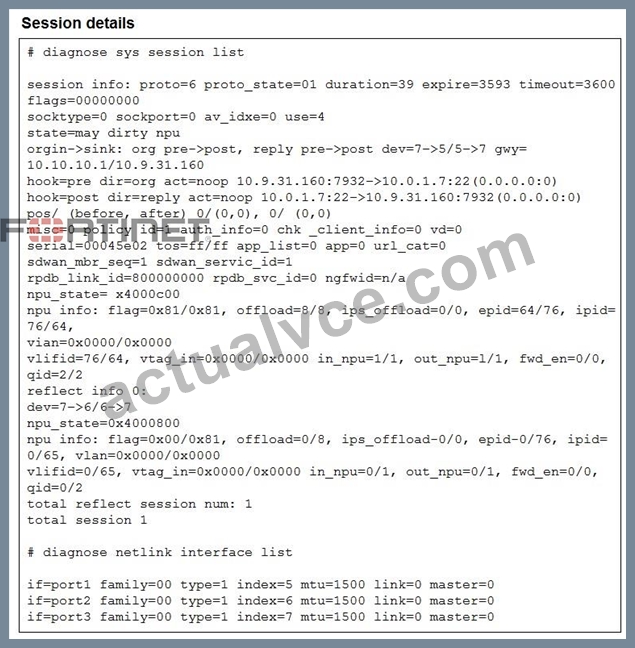
The exhibit shows the details of a session and the index numbers of some relevant interfaces on a FortiGate device that supports hardware offloading.
Based on the information shown in the exhibits, which two conclusions can you draw? (Choose two.)
- A. The auxiliary session can be offloaded to hardware.
- B. By default, FortiGate offloads symmetric and asymmetric flows.
- C. The original direction of the symmetric traffic flows from port3 to port2.
- D. The reply direction of the asymmetric traffic flows from port2 to port3.
Answer: C,D
Explanation:
The session details show the symmetric flow's original direction as port3 # port2.
The asymmetric flow's reply direction is listed as port2 # port3.
NEW QUESTION # 25
The administrator uses the FortiManager SD-WAN overlay template to prepare an SD-WAN deployment.
Using information provided through the SD-WAN overlay template wizard, FortiManager creates templates ready to install on the spoke and hub devices.
What are the three templates created by the SD-WAN overlay template for a spoke device? (Choose three.)
- A. BGP template
- B. Rules template
- C. IPsec tunnel template
- D. Static route template
- E. CLI template
Answer: A,B,C
Explanation:
Rules template # Defines the SD-WAN rules for traffic steering.
BGP template # Configures dynamic routing for overlay tunnels.
IPsec tunnel template # Builds the IPsec VPN tunnels from the spoke to the hubs.
NEW QUESTION # 26
When you use the command diagnose sys session list, how do you identify the sessions that correspond to traffic steered according to SD-WAN rules?
- A. You identify sessions steered according to SD-WAN rules with the data vwl_mbr_seq.
- B. You identify sessions steered according to SD-WAN rules with the data 3dwan_service_id.
- C. You cannot identify SD-WAN sessions. You must use the sdwar. session filter.
- D. You identify sessions steered according to SD-WAN rules with the flag vwl.
Answer: B
Explanation:
When using the diagnose sys session list command, SD-WAN-specific session steering is indicated by the presence of the sdwan_service_id field in the session data. This identifier ties the session directly to a specific SD-WAN rule or service. As noted in the Fortinet documentation: "Sessions that are handled according to SD- WAN rules will include a service ID tag (sdwan_service_id) in their session listing. This allows administrators to correlate live sessions with SD-WAN policy matches for troubleshooting and visibility." This is a crucial diagnostic tool, as it distinguishes between traffic managed by traditional routing and that explicitly controlled by SD-WAN steering logic, aiding in operational insight and troubleshooting.
References:
[FCSS_SDW_AR-7.4 1-0.docx Q15]
FortiOS 7.4 CLI Reference, "diagnose sys session list: SD-WAN Service ID Tagging" SD-WAN 7.4 Concept Guide, Section: "Session Identification for SD-WAN Traffic"
NEW QUESTION # 27
(Refer to the exhibit. The administrator configured two SD-WAN rules to load balance the traffic.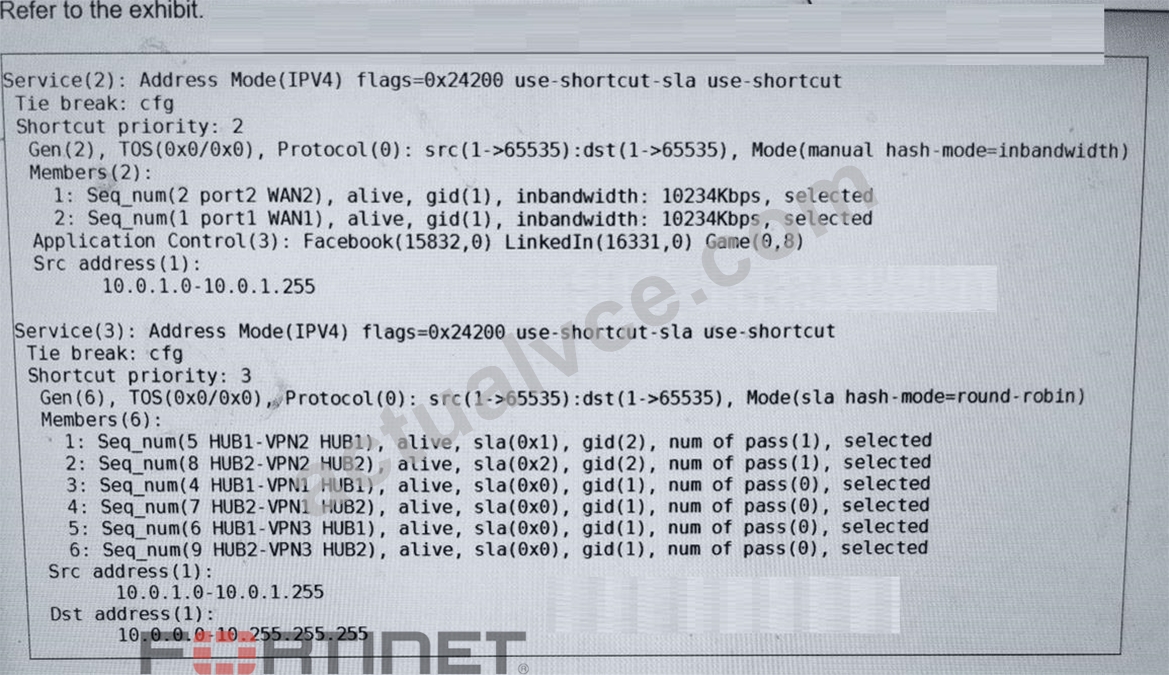
Which interfaces does FortiGate use to steer the traffic from 10.0.1.124 to 10.0.0.254? Choose one answer.)
- A. HUB1-VPN2 or HUB2-VPN2
- B. HUB2-VPN2
- C. Any interface in the HUB1 or HUB2 zones
- D. port1 or port2
Answer: A
Explanation:
The exhibit shows the runtime details of two SD-WAN services (rules):
Service(2)
* Mode(manual hash-mode=inbandwidth)
* Members(2): port2 (WAN2), port1 (WAN1)
* Application matching: Facebook, LinkedIn, Game
* Source: 10.0.1.0-10.0.1.255This rule is clearly intended for internet/DIA application steering and does not show a corporate destination range.
Service(3)
* Mode(sla hash-mode=round-robin)
* Members(6): HUB1-VPN1/2/3 and HUB2-VPN1/2/3
* Source: 10.0.1.0-10.0.1.255
* Destination: 10.0.0.0-10.255.255.255
Traffic from 10.0.1.124 to 10.0.0.254 matches Service(3) because the destination IP 10.0.0.254 falls within the destination range 10.0.0.0-10.255.255.255.
Within Service(3), the member list shows SLA results per interface:
* HUB1-VPN2 has sla(0x1) and num of pass(1)
* HUB2-VPN2 has sla(0x2) and num of pass(1)
* The remaining members (HUB1-VPN1, HUB2-VPN1, HUB1-VPN3, HUB2-VPN3) show sla(0x0) and num of pass(0) This indicates that, for Service(3), only HUB1-VPN2 and HUB2-VPN2 are currently meeting the SLA requirements (passing), and because the rule uses hash-mode=round-robin, FortiGate load-balances sessions across the passing members.
Therefore, FortiGate will steer the traffic using HUB1-VPN2 or HUB2-VPN2, which corresponds to Option B.
NEW QUESTION # 28
Exhibit.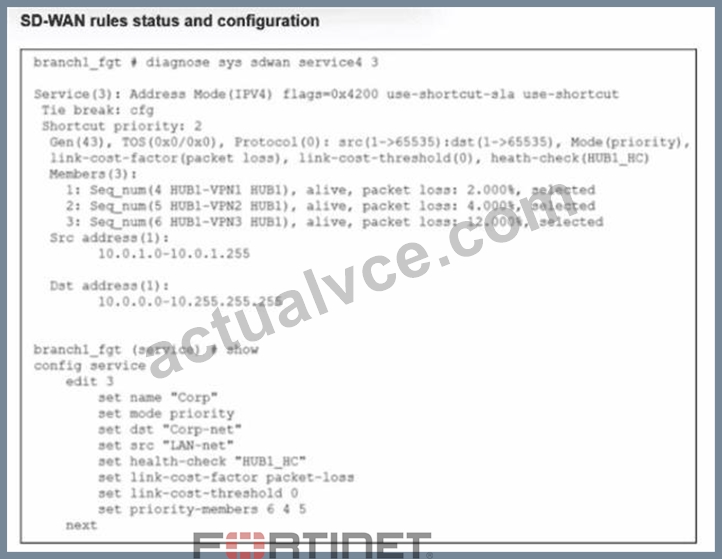
Refer to the exhibit, which shows the SD-WAN rule status and configuration.
Based on the exhibit, which change in the measured packet loss will make HUB1-VPN3 the new preferred member?
- A. When HUB1-VPN1 has 4% packet loss
- B. When HUB1-VPN1 has 12% packet loss
- C. When all three members have the same packet loss
- D. When HUB1-VPN3 has 4% packet loss
Answer: C
NEW QUESTION # 29
You used the HUB IPsec_Recommended and the BRANCH IPsec_Recommended templates to define the overlay topology. Then, you used the SD-WAN template to define the SD- WAN members, rules, and performance SLAs.
You applied the changes to the devices and want to use the FortiManager monitors menu to get a graphical view that shows the status of each SD-WAN member.
Which statement best explains how to obtain this graphical view?
- A. Use the SD-WAN monitor template view to get a map view of the branches, hub, and tunnel status, including the SLA pass or missed status.
- B. Use the VPN monitor map view to get a map view of the branches, hub, and tunnel status, including the SLA pass or missed status.
- C. Use the SD-WAN monitor asset view to get a donut view and a table view that shows the status of each device and the SLA status of each SD-WAN member.
- D. Use the SD-WAN monitor table view to get a donut view and a table view that shows the status of each SD-WAN member, including the SLA pass or missed status.
Answer: D
Explanation:
The SD-WAN monitor's table view in FortiManager provides a donut visualization plus a detailed table that shows each SD-WAN member's status and SLA pass/miss, giving the per-member health view you're after.
NEW QUESTION # 30
An administrator is configuring SD-WAN to load balance their network traffic. Which two things should they consider when setting up SD-WAN? (Choose two.)
- A. When applicable. FortiGate load balances the traffic through all members that meet the SLA target.
- B. You can select the outbandwidth hash mode with all strategies that allow load balancing.
- C. Only the manual and best-quality strategies allow SD-WAN load balancing.
- D. SD-WAN load balancing is possible only using the best quality and lowest cost (SLA) strategies.
Answer: A,B
NEW QUESTION # 31
Refer to the exhibits.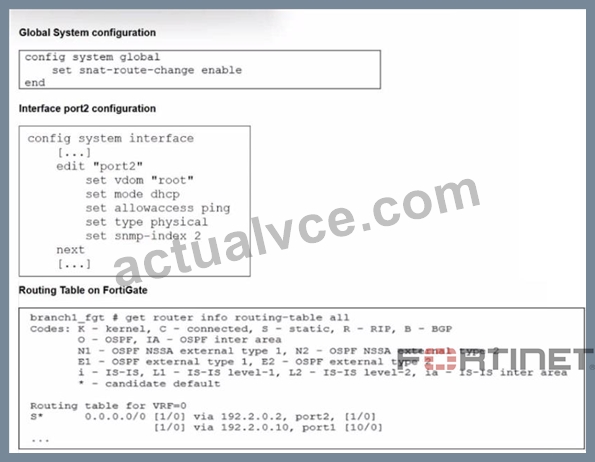
The exhibits show the source NAT (SNAT) global setting. port2 interface settings, and the routing table on FortiGate.
The administrator increases the member priority on port2 to 20.
Upon configuration changes and the receipt of new packets, which two actions does FortiGate perform on existing sessions established over port2? (Choose two.)
- A. FortiGate updates the gateway information of the sessions with SNAT so that they use port1 instead of port2.
- B. FortiGate continues routing all existing sessions over port2.
- C. FortiGate flags the SNAT session as dirty only if the administrator has assigned an IP pool to the firewall policies with NAT.
- D. FortiGate flags the sessions as dirty.
- E. FortiGate routes only new sessions over port2.
Answer: A,D
Explanation:
When the member priority of a port is increased (e.g., port2 to 20), FortiGate evaluates existing sessions and applies "dirty" flags where applicable. The SD-WAN session management mechanism is described in detail:
"Upon a change in SD-WAN member priority, all existing sessions using that member are marked as dirty.
For SNAT sessions, the gateway information is updated to ensure future packets are routed through the newly preferred member, in this case, port1. This automatic re-evaluation allows SD-WAN to dynamically respond to topology or priority changes, maintaining optimal routing." This is fundamental to seamless failover and session persistence in Fortinet SD-WAN, ensuring active flows are redirected based on updated priorities or health status.
References:
[FCSS_SDW_AR-7.4 1-0.docx Q13]
FortiOS 7.4 SD-WAN Concept Guide, "Session Management During Path Change" FortiGate CLI Reference: diagnose sys session list
NEW QUESTION # 32
Refer to the exhibits.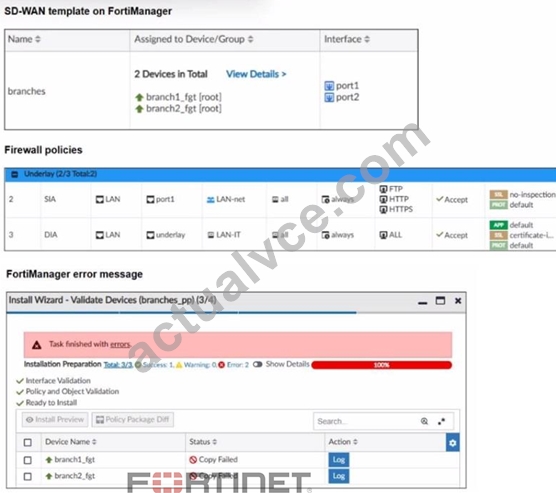
You use FortiManager to manage the branch devices and configure the SD-WAN template. You have configured direct internet access (DIA) for the IT department users. Now. you must configure secure internet access (SIA) for all local LAN users and have set the firewall policies as shown in the second exhibit.
Then, when you use the install wizard to install the configuration and the policy package on the branch devices, FortiManager reports an error as shown in the third exhibit.
Which statement describes why FortiManager could not install the configuration on the branches?
- A. You cannot install firewall policies that reference an SD-WAN member.
- B. You must direct SIA traffic to a VPN tunnel.
- C. You cannot install SIA and DIA rules on the same device.
- D. You cannot install firewall policies that reference an SD-WAN zone.
Answer: A
Explanation:
FortiManager enforces a strict distinction:
"Firewall policies must reference SD-WAN zones, not individual SD-WAN members, when used in conjunction with SD-WAN templates. Attempting to install a policy that references a specific member (interface) will result in a deployment error, as member-level targeting is not supported in SD-WAN policy abstraction. This enforces centralized policy consistency and proper SD-WAN operation." Ensuring policies target zones allows FortiGate to dynamically select the optimal member.
NEW QUESTION # 33
As an IT manager for a healthcare company, you want to delegate the installation and management of your SD-WAN deployment to a managed security service provider (MSSP). Each site must maintain direct internet access and ensure that it is secure. You expected significant traffic flow between the sites and want to delegate as much of the network administration and management as possible to the MSSP.
Which two MSSP deployment blueprints best address the customer's requirements? (Choose two.)
- A. Install the hub and spokes at the customer premises and enable the MSSP to manage the SD-WAN deployment using FortiManager with a dedicated ADOM.
- B. Install a dedicated hub at the MSSP premises for the new customer, and install the spokes at the customer premises.
- C. Use a shared hub at the MSSP premises and a dedicated hub at the customer premises and install the spokes at the customer premises.
- D. Use a shared hub at the MSSP premises with a dedicated VDOM for the new customer, and install the spokes at the customer premises.
Answer: B,D
Explanation:
Hosting the hub at the MSSP centralizes installation, security, and ongoing management while each site (spoke) keeps local DIA. This can be done multi-tenant with a shared hub using a dedicated VDOM or with a fully dedicated hub per customer for stricter isolation and control, both meeting the requirement to delegate administration to the MSSP and support high inter-site traffic.
NEW QUESTION # 34
Refer to the exhibit.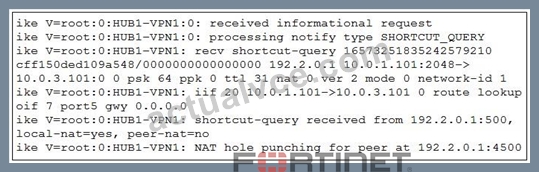
Which statement best describe the role of the ADVPN device in handling traffic?
- A. This is a spoke that has received a direct shortcut query from a remote spoke.
- B. This is a hub, and two spokes, 192.2.0.1 and 10.0.3.101, establish a shortcut.
- C. This is a spoke that has received a shortcut query from a remote hub.
- D. This is a hub that has received a shortcut query from a spoke and has forwarded it to another spoke.
Answer: B
Explanation:
The log shows messages on HUB1-VPN1 where the device processes a SHORTCUT_QUERY and performs NAT hole punching (peer at 192.2.0.1:4500). This indicates that the device is acting as a hub, helping two spokes (192.2.0.1 and 10.0.3.101) establish a direct ADVPN shortcut tunnel between each other, instead of routing their traffic through the hub.
NEW QUESTION # 35
You manage an SD-WAN topology. You will soon deploy 50 new branches.
Which three tasks can you do in advance to simplify this deployment? (Choose three.)
- A. Update the DHCP server configuration.
- B. Create a ZTP template.
- C. Create policy blueprint.
- D. Define metadata variables value for each device.
- E. Create model devices.
Answer: B,C,E
Explanation:
When planning to deploy a large number of branches (e.g., 50), Fortinet recommends several preparatory steps to simplify and automate the rollout. Creating model devices allows you to predefine configurations and settings that can be cloned or adapted for each branch, saving time and minimizing manual errors. Preparing a Zero Touch Provisioning (ZTP) template enables automatic onboarding and provisioning of new FortiGates as soon as they come online, reducing manual intervention. Lastly, creating a policy blueprint allows for standardized policy deployment across all branches, ensuring consistent security and SD-WAN rule enforcement. This holistic approach streamlines the deployment process, allows for rapid scaling, and ensures that all devices are configured according to corporate policy from day one.
References:
[FCSS_SDW_AR-7.4 1-0.docx Q8]
Fortinet SD-WAN 7.4 Reference Architecture, "ZTP and Model Device Strategies for Scalable Rollouts" FortiManager Admin Guide, "Policy Blueprints and Automation for Branch Deployment"
NEW QUESTION # 36
(In the context of SD-WAN, the terms underlay and overlay are commonly used to categorize links.
Which two statements about underlay and overlay links are correct? Choose two answers.)
- A. A VLAN is a type of overlay link.
- B. Overlay links provide routing flexibility.
- C. Wireless connections can be used to build overlay links.
- D. Only wired connections can be used as underlay links.
- E. FortiLink interface is considered an underlay link.
Answer: B,C
Explanation:
In Fortinet SD-WAN architecture, underlay and overlay have distinct meanings:
* Underlay links are the physical or logical transport networks that provide basic IP connectivity (for example, broadband, MPLS, LTE/5G).
* Overlay links are virtual tunnels (such as IPsec VPNs) built on top of the underlay, providing abstraction, routing control, and segmentation.
Option B is correct.
Overlay links (for example, IPsec tunnels used in SD-WAN and ADVPN) decouple routing from the physical transport. This allows dynamic path selection, segmentation, and flexible routing policies independent of the underlay. Providing routing flexibility is a core purpose of overlays in SD-WAN.
Option D is correct.
Wireless connections such as LTE or 5G can be used as underlay transports, and overlay tunnels can be built over them. Fortinet SD-WAN fully supports building IPsec overlays on wireless underlays, making wireless links valid for overlay construction.
Why the other options are incorrect:
* Option A is incorrect because a VLAN is a Layer 2 segmentation mechanism, not an SD-WAN overlay link.
* Option C is incorrect because FortiLink is used for internal management and switch/AP connectivity, not as a WAN underlay for SD-WAN.
* Option E is incorrect because underlay links can be wired or wireless; they are not limited to wired connections.
Therefore, the two correct statements are B and D.
NEW QUESTION # 37
Exhibit.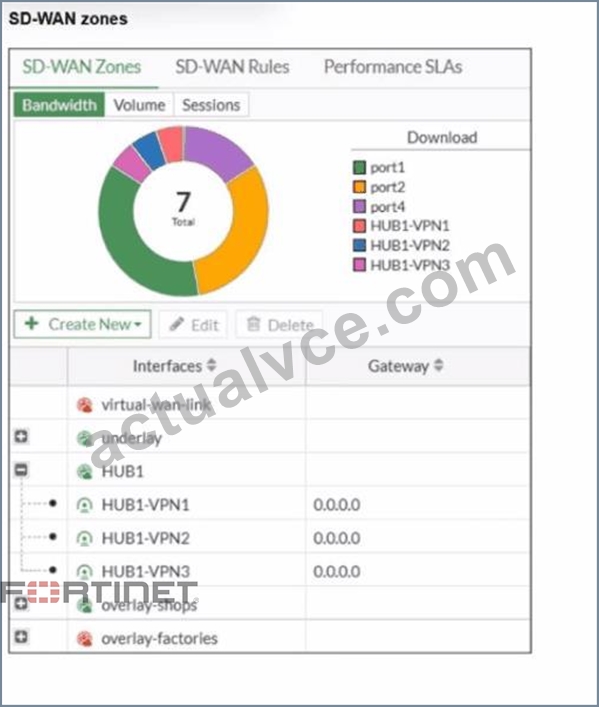
Refer to the exhibit, which shows an SD-WAN zone configuration on the FortiGate GUI. What can you conclude about the zone and member configuration on this device?
- A. The underlay zone contains three members.
- B. You can delete the virtual-wan-link zones.
- C. You can move HUB1-VPN3 from the HUB1 zone to the overlay-shops zone.
- D. The overlay-factories zone contains no member.
Answer: D
Explanation:
In the SD-WAN GUI, the absence of members in a zone is visually represented, and the Fortinet guide confirms:
"If a zone such as overlay-factories contains no members, it will be displayed as empty in the SD-WAN GUI.
This may occur when the zone is reserved for future expansion, or if members have been temporarily removed for maintenance or reconfiguration. Traffic cannot be steered via an empty zone until at least one SD-WAN member is added." Such visual cues help operators quickly assess configuration status and readiness.
NEW QUESTION # 38
When a customer delegate the installation and management of its SD-WAN infrastructure to an MSSP, the MSSP usually keeps the hub within its infrastructure for ease of management and to share costly resources.
In which two situations will the MSSP install the hub in customer premises? (Choose two.)
- A. The administrator expects a large volume of traffic between the branches.
- B. The customer requires SIA with centralized breakout.
- C. The customer expects a large amount of VoIP traffic.
- D. The majority of the branch traffic is directed to a corporate data center.
Answer: A,D
NEW QUESTION # 39
......
NSE6_SDW_AD-7.6 Dumps are Available for Instant Access: https://learningtree.actualvce.com/Fortinet/NSE6_SDW_AD-7.6-valid-vce-dumps.html