
Exam Name: SOA Design & Architecture Lab with Services & Microservices
Certification Provider: SOA
Corresponding Certification: Certified SOA Architect

Over 39956+ Satisfied Customers
Instant Download SOA : S90.08B

Check Updated on: Oct 21, 2026
No. of Questions: 17 Questions & Answers with Exam Engine
Download Limit: Unlimited
Instant Download: Upon successful payment, Our systems will automatically send the product you have purchased to your mailbox by email. (If not received within 12 hours, please contact us. Note: don't forget to check your spam.)
100% Money Back Guarantee
ActualVCE has an unprecedented 99.6% first time pass rate among our customers.  We're so confident of our products that we provide no hassle product exchange.
- Best exam practice material
- Three formats are optional
- 10+ years of excellence
- 365 Days Free Updates
- Learn anywhere, anytime
- 100% Safe shopping experience


In 2026, time management inside the exam hall separates prepared candidates from lucky ones. ActualVCE trains that skill for the S90.08B exam with 17 practice questions and a test engine where you can set your own time limit per session.
SOA S90.08B Exam Syllabus Topics:
| Section | Weight | Objectives |
|---|---|---|
| Architecture & Lab Application | 25% | - REST service remodeling, API gateway and case studies - Service composition, orchestration and choreography - Microservices deployment and integration |
| Service Technology Concepts | 25% | - XML, JSON, HTTP, REST and Web service contracts - Messaging patterns and protocols - Cloud models: IaaS, PaaS, SaaS, scaling strategies |
| SOA Design Principles & Service Modeling | 25% | - Service inventory and layer design - Eight service-orientation design principles - Service identification, modeling and boundary definition |
| Fundamental SOA, Services & Microservices | 25% | - SOA drivers, goals and benefits - Core service concepts and characteristics - Microservices paradigm and comparison with SOA |
Practicing for the SOA Design & Architecture Lab with Services & Microservices Exam: FAQ
After each practice session, the online test engine records which questions you answered incorrectly and reminds you to revisit them in your next round. Reviewing your own mistakes daily shows you clearly where your weaknesses and strengths lie, so every session builds on the last instead of starting from scratch.
The SOA Design & Architecture Lab with Services & Microservices exam contains 17 questions, and you will have 90–120 minutes to complete them. Practicing the full volume under a timer is the closest thing to rehearsing the real exam.
Many candidates combine practice questions with official training. Recommended options include:
Yes. The online test engine lets you set a time limit for each practice session, so you can train yourself to allocate minutes per question the way you will need to in the real S90.08B exam. Working under a clock at home makes time pressure on exam day feel routine rather than alarming.
The SOA Design & Architecture Lab with Services & Microservices exam requires a score of 70% to pass, and the official registration fee is $125–$150 USD. Since the exam fee is a real investment, thorough preparation is the most practical way to protect it.
Recommended completion of S90.01B, S90.02B, S90.03B exams; 6+ months SOA/architecture experience
You can confirm the current eligibility requirements on the official S90.08B exam page before you register.
The SOA Design & Architecture Lab with Services & Microservices practice questions are organized around the official exam objectives. Key topics include:
- SOA Design Principles & Service Modeling (25%)
- Architecture & Lab Application (25%)
- Service Technology Concepts (25%)
Daily practice mapped to these topics keeps your preparation balanced across the whole syllabus.
You can register for the SOA Design & Architecture Lab with Services & Microservices exam through the official channels:
This package includes 17 practice questions for the SOA Design & Architecture Lab with Services & Microservices exam. Every answer is verified by an experienced team of experts, so you can trust what you study.
SOA Design & Architecture Lab with Services & Microservices Sample Questions:
Refer to Exhibit.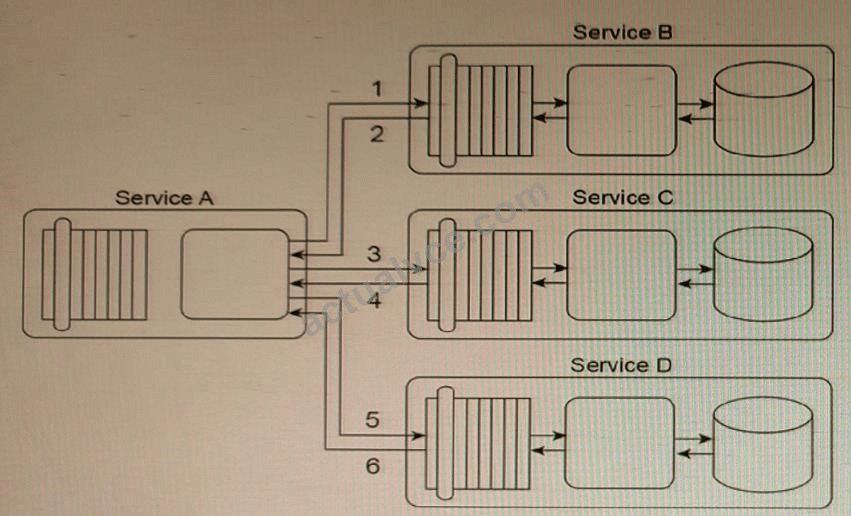
Service A is a task service that is required to carry out a series of updates to a set of databases in order to complete a task. To perform the database updates. Service A must interact with three other services that each provides standardized data access capabilities.
Service A sends its first update request message to Service B (1), which then responds with a message containing either a success or failure code (2). Service A then sends its second update request message to Service C (3), which also responds with a message containing either a success or failure code (4). Finally, Service A sends a request message to Service D (5), which responds with its own message containing either a success or failure code (6).
Services B, C and D are agnostic services that are reused and shared by multiple service consumers. This has caused unacceptable performance degradation for the service consumers of Service A as it is taking too long to complete its overall task. You've been asked to enhance the service composition architecture so that Service A provides consistent and predictable runtime performance. You are furthermore notified that a new type of data will be introduced to all three databases. It is important that this data is exchanged in a standardized manner so that the data model used for the data in inter-service messages is the same.
What steps can be taken to fulfill these requirements?
- A. The Compensating Service Transaction pattern can be applied so that exception logic is executed to notify Service A whenever the data access logic executed by Service B, C, or D takes too long. If the execution time exceeds a predefined limit, then the overall service activity is cancelled and a failure code is returned to Service A. The Schema Centralization pattern is applied to ensure that all services involved in the composition use the same schemas to represented the data consistently.
- B. The Service Fagade pattern is applied to all services in order to create an intermediary processing layer within each service architecture. The Content Negotiation pattern is applied so that each service fagade component within each service architecture is equipped with the logic required to defer request messages to other service instances when concurrent usage of the service is high, and to further apply the conversation logic necessary to convert proprietary data from a database into the standardized XML schema format.
- C. The Composition Autonomy pattern can be applied to establish an isolated environment in which redundant implementations of Services B, C and D are accessed only by Service A. The Canonical Schema pattern can be applied to ensure that the new type of data is represented by the same data model, regardless of which service sends or receives a message containing the data.
- D. The Redundant Implementation pattern is applied to Service A, along with the Service Instance Routing pattern. This allows for multiple instances of Service A to be created across multiple physical implementations, thereby increasing scalability and availability. The Dual Protocols pattern is applied to all services to support proprietary and standardized data models.
Correct Answer: C 🗳️
Explanation: Only visible for ActualVCE members. You can sign-up / login (it's free).
Refer to Exhibit.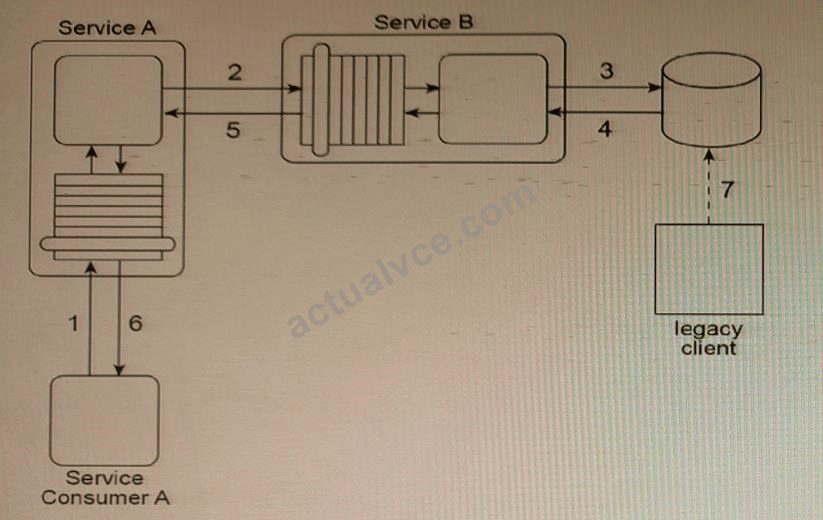
Service A is an entity service that provides a Get capability which returns a data value that is frequently changed.
Service Consumer A invokes Service A in order to request this data value (1). For Service A to carry out this request, it must invoke Service B (2), a utility service that interacts (3, 4) with the database in which the data value is stored. Regardless of whether the data value changed, Service B returns the latest value to Service A (5), and Service A returns the latest value to Service Consumer A (6).
The data value is changed when the legacy client program updates the database (7). When this change will occur is not predictable. Note also that Service A and Service B are not always available at the same time.
Any time the data value changes, Service Consumer A needs to receive It as soon as possible. Therefore, Service Consumer A initiates the message exchange shown In the figure several times a day. When it receives the same data value as before, the response from Service A Is ignored. When Service A provides an updated data value, Service Consumer A can process it to carry out its task.
The current service composition architecture is using up too many resources due to the repeated invocation of Service A by Service Consumer A and the resulting message exchanges that occur with each invocation.
What steps can be taken to solve this problem?
- A. The Asynchronous Queuing pattern can be applied so that messaging queues are established between Service A and Service B and between Service Consumer A and Service A. This way, messages are never lost due to the unavailability of Service A or Service B.
- B. The Event-Driven Messaging pattern can be applied by establishing a subscriber-publisher relationship between Service A and Service B. This way, every time the data value is updated, an event is triggered and Service B, acting as the publisher, can notify Service A, which acts as the subscriber. The Asynchronous Queuing pattern can be applied between Service A and Service B so that the event notification message sent out by Service B will be received by Service A, even when Service A is unavailable.
- C. The Event-Driven Messaging pattern can be applied by establishing a subscriber-publisher relationship between Service Consumer A and a database monitoring agent introduced through the application of the Service Agent pattern. The database monitoring agent monitors updates made by the legacy client to the database. This way, every time the data value is updated, an event is triggered and the database monitoring agent, acting as the publisher, can notify Service Consumer A, which acts as the subscriber.
The Asynchronous Queuing pattern can be applied between Service Consumer A and the database monitoring agent so that the event notification message sent out by the database monitoring agent will be received by Service Consumer A, even when Service Consumer A is unavailable. - D. The Event-Driven Messaging pattern can be applied by establishing a subscriber-publisher relationship between Service Consumer A and Service A. This way, every time the data value is updated, an event is triggered and Service A, acting as the publisher, can notify Service Consumer A, which acts as the subscriber. The Asynchronous Queuing pattern can be applied between Service Consumer A and Service A so that the event notification message sent out by Service A will be received by Service Consumer A, even when Service Consumer A is unavailable.
Correct Answer: B 🗳️
Explanation: Only visible for ActualVCE members. You can sign-up / login (it's free).
Viewing page 1 out of 9 pages.
Viewing questions 1-2 out of 17 questions.
 1128 Customer ReviewsCustomers Feedback (* Some similar or old comments have been hidden.)
I passed S90.08B test with smashing scores.

Ulysses
I bought your S90.08B practice dumps on Monday and attended the exam on Friday. And it is all because of your help! Many thinks!

Clyde
Very detailed exam dumps for the S90.08B S90.08B certification exam. Passed with 98% marks. I studied with ActualVCE. Satisfied with their content. I suggest everyone refer to these before taking the original exam.

Sibyl
Passed S90.08B exam with about 95%. Excellent S90.08B exam materials for the S90.08B certification exam. If you want to pass too, this is really a good choice to buy these S90.08B practice questions !

Blithe
I want to pass S90.08B exam at first trial, I buy this dumps. Luckily ,right choise. Passed exam easily.

Hazel

This S90.08B material helps me a lot, thanks honestly.

Mignon

The ActualVCE contains many valid materils, I have passed S90.08B by using this material.

Robin
Passing S90.08B exam make me feel so nice! Thank you, all the team!

Yvonne
I took the S90.08B exam just hours before and finished with a perfect score. I had only an hour or so a day to prepare for my S90.08B certification exam.

James
I have failed the S90.08B exam once, but S90.08B exam dumps in ActualVCE helped me pass the exam this time, really appreciate!

Doreen
Your name stands true!! THANK YOU !!!
I just passed my S90.08B exam today.

Beau
Clearing my dream certification exam with utmost ease was nothing less than a dream come true. I got it with minimum efforts only by the use of ActualVCE S90.08B real exam dumps.

Orville
After compared with the other website, I find the pass rate of this S90.08B study dumps is 100% and the service is also good. And I passed the S90.08B exam yesterday. You can trust.

Miranda
Absolutely satisfied with the dumps at ActualVCE for the S90.08B certification exam. Latest questions and answers included in them. I suggest all to prepare for the exam with these dumps.

Leonard
S90.08B exam is not easy for me. Luckily, my firend introductd S90.08B dump to me. I have passed my exam.

Alva
I took exam today and used this dump, passed! The version is completed and accurate.

Troy
If you don't want to waste your money, ActualVCE Pdf file for Dynamics S90.08B is the ultimate guide to pass your exams with no hustle. Experienced suggestion. I got 92% marks.

Margaret
Related Exams
Related Posts
Instant Download S90.08B
After Payment, our system will send you the products you purchase in mailbox in a minute after payment. If not received within 2 hours, please contact us.
365 Days Free Updates
Free update is available within 365 days after your purchase. After 365 days, you will get 50% discounts for updating.

Money Back Guarantee
Full refund if you fail the corresponding exam in 60 days after purchasing. And Free get any another product.
Security & Privacy
We respect customer privacy. We use McAfee's security service to provide you with utmost security for your personal information & peace of mind.
